Product Descriptions A-Z
Click on the country of origin to go the corresponding page in our wholesale catalog. Unfortunately, a username and password are required to see pricing. Qualified customers can apply for an account on our registration page.

Click on the country of origin to go the corresponding page in our wholesale catalog. Unfortunately, a username and password are required to see pricing. Qualified customers can apply for an account on our registration page.
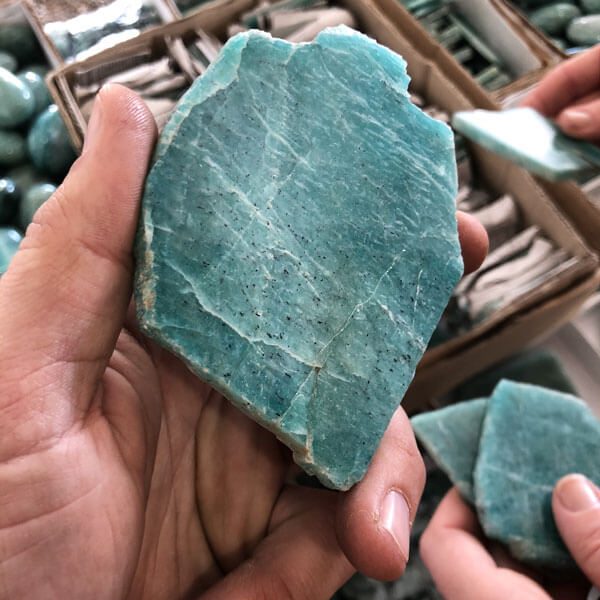
Amazonite (Madagascar): Amazonite is a blue or green variety of microcline feldspar. It was mistakenly named “Amazon stone” after the Amazon River. European explorers believed greenstone jewelry worn by indigenous Brazilians was amazonite. It was likely nephrite jade instead. According to current theories amazonite may be colored by trivalent lead (Pb+3) and water inclusions. Exposure to natural sources of radiation underground oxidizes the lead and produces hydroxyl radicals (oxygen bonded to hydrogen) from the water. The hydroxyl radicals create vacant positions in amazonite’s crystal structure by displacing some of its oxygen. These are filled by the lead ions. Other research suggests that green amazonite may have divalent iron (Fe+2) as a coloring agent instead.
Availability: Regularly in stock.
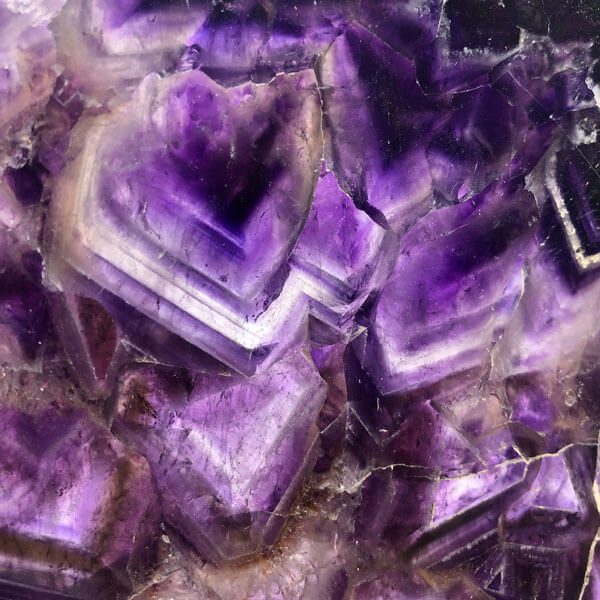
Amethyst (Madagascar): Amethyst is a purple variety of quartz. According to current theories exposure to natural underground radiation causes trace amounts of tetravalent iron (Fe4+) to replace some of its silicon. This change in its crystal structure creates its color. The name comes from the Greek amethystos (“not intoxicating”). People sculpted drinking cups out of amethyst in antiquity believing that it would prevent drunkenness.
Availability: Variable.
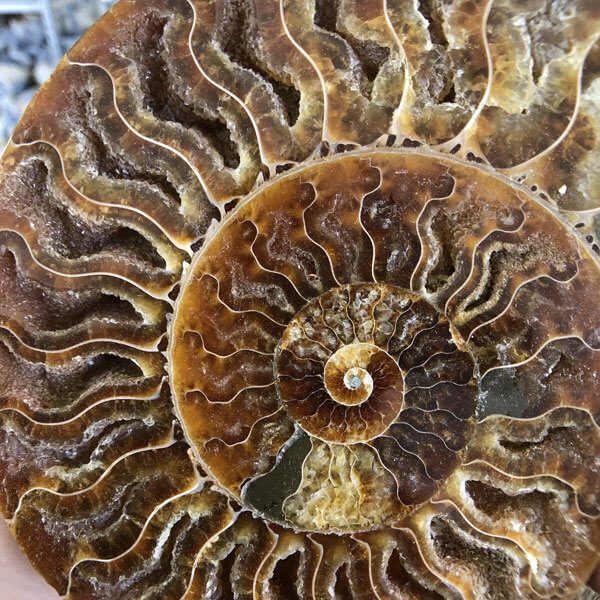
Ammonites (Madagascar): The ammonites are an extinct group of marine mollusks. They may have resembled a squid with an external coiled shell. The name is derived from Hammonis cornu (Latin, “the horns of Amun”), an Egyptian ram headed god. People in antiquity believed the spiral shaped fossils were his emblem. The ammonoids first appear in the fossil record during the Devonian Period (~419 million years ago) and went extinct with the dinosaurs at the end of the Cretaceous Period (~66 million years ago). For age, locality, and known genera, please visit the fossil map on our website.
Availability: Regularly in stock.
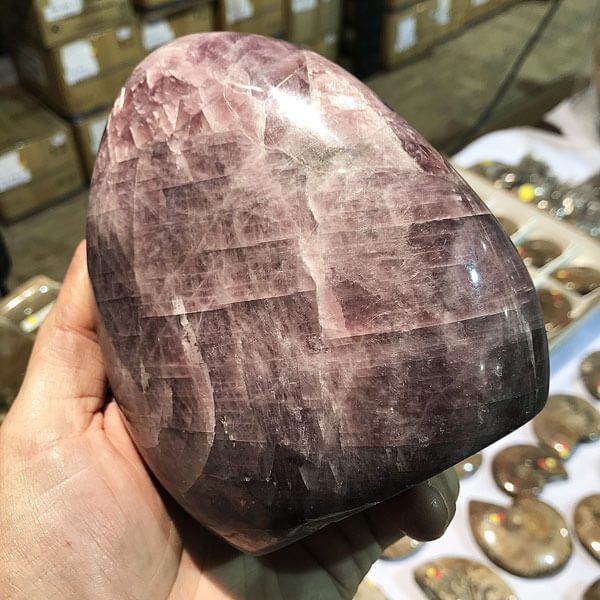
Anhydrite (Madagascar): Both anhydrite and gypsum (“selenite”) are composed of calcium sulfate, a compound of calcium, sulfur, and oxygen. They differ in their water content. Anhydrite may convert to gypsum when exposed to water and gypsum into anhydrite when it becomes dehydrated. The name comes from the Greek anudros (an- “without” + hudor “water”). Anhydrite is better known in the mineral market as “angelite”, after vast deposits of a pale blue color were discovered in Peru during the mid 1980’s. Madagascan purple anhydrite may form with green epidote and pink calcite.
Availability: Not regularly in stock.
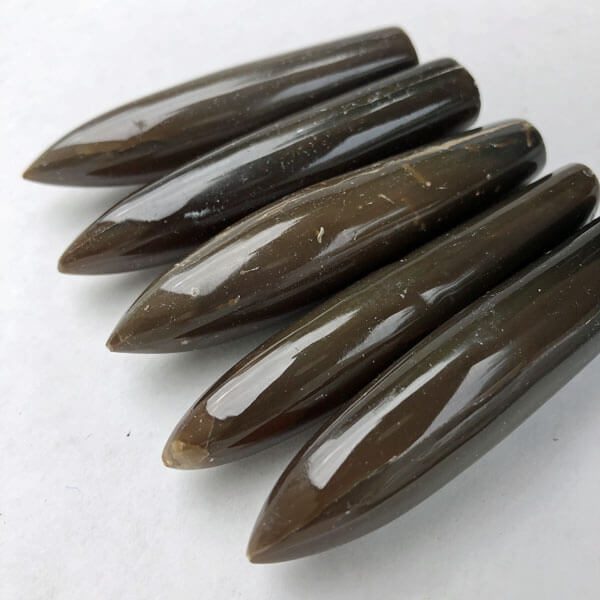
Belemnite (Madagascar): The belemnites are an extinct group of cephalopods. They resembled a modern octopus but had ten arms of equal length, covered in hooks, and a series of internal shells used for both buoyancy and ballast. The most commonly preserved one is the bullet like guard, more technically called a rostrum (Latin “beak”), originally located inside the tail end of the animal. The name belemnite comes from the Greek belemnon (“dart”), after the rostrum’s pointed shape. For age, locality, and known genera, please visit the fossil map on our website.
Availability: Not regularly in stock.
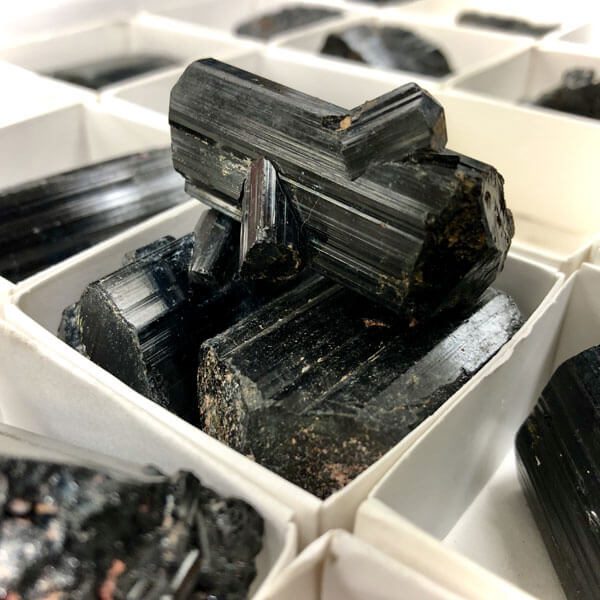
Black Tourmaline (Madagascar): The name tourmaline refers to a group of related borosilicate minerals, containing boron, silicon, and oxygen. They all have the same crystal structure but differ in their specific chemical makeup. The name comes from the Sinhalese toramalli (“gemstone”). The vast majority of tourmaline is the sodium and iron rich black variety. Black tourmaline was known historically as schorl, after the mining village of Zschorlau in Germany.
Availability: Regularly in stock.
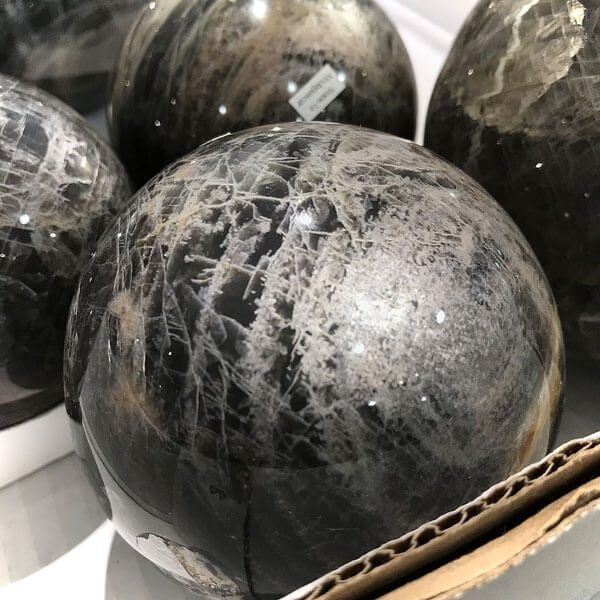
Black Moonstone (Madagascar): The name moonstone is given to feldspars that display a moonlight like glow on their surface called adularescence. The word comes from the mineral adularia, named after Mount Adula in Switzerland. It is produced by the diffraction of light off microscopic layers of alternating orthoclase and albite feldspars. Thinner layers produce a blue flash and thicker ones white. The body color of black, pink, and red moonstone is typically caused by iron oxides.
Availability: Regularly in stock.
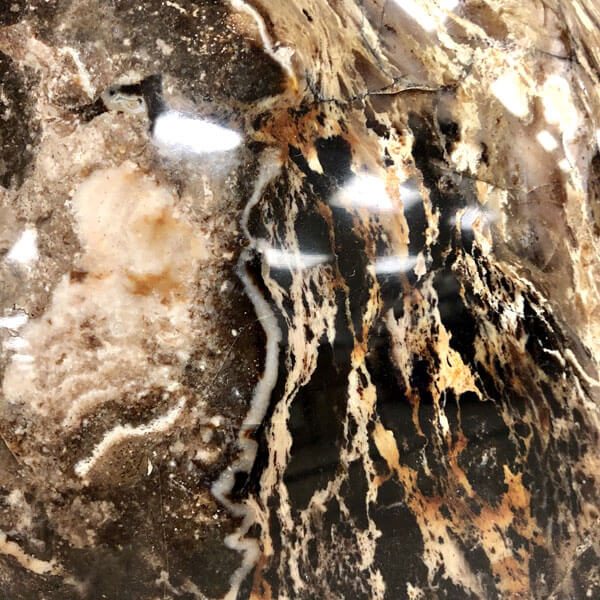
Black Opal (Madagascar): Opal is a mineraloid, a material that lacks a crystal structure but has a regular composition. It may be created by the minerals cristobalite and tridymite or amorphous silica. It is commonly divided into precious opal, which displays a play of color, and common opal. Both consist of silica spheres with interstitial silica and water, filling in the gaps between them. If these spheres are similarly sized and regularly stacked, their arrangement diffracts light producing its play of color. While common opal cannot flash, it may be colored by trace mineral inclusions instead.
Availability: Regularly in stock.
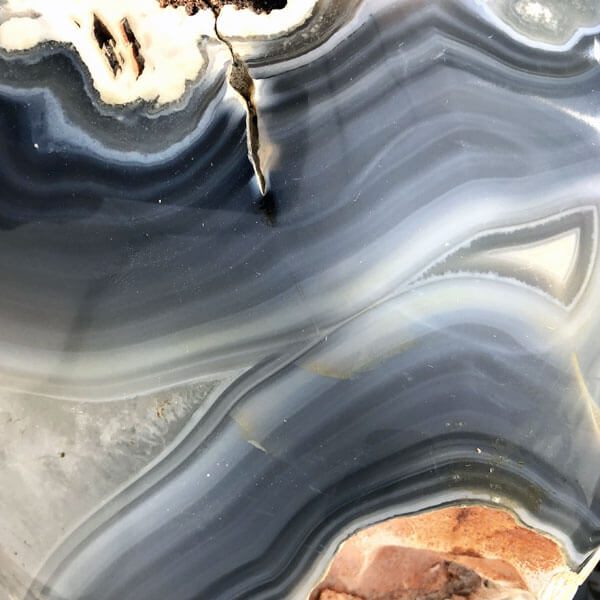
Blue Agate (Madagascar): This Madagascan agate either has blue to gray banding or white splotches against a blue background. Since the latter patterning can resemble a killer whale, it is often called “orca agate”. While natural agate is colored red, orange, and yellow by iron oxides, blues and grays are often structural instead, created by Rayleigh scattering. Light is thought to bounce off its microscopic chalcedony fibers in multiple directions and appear blue.
Availability: Not regularly in stock.
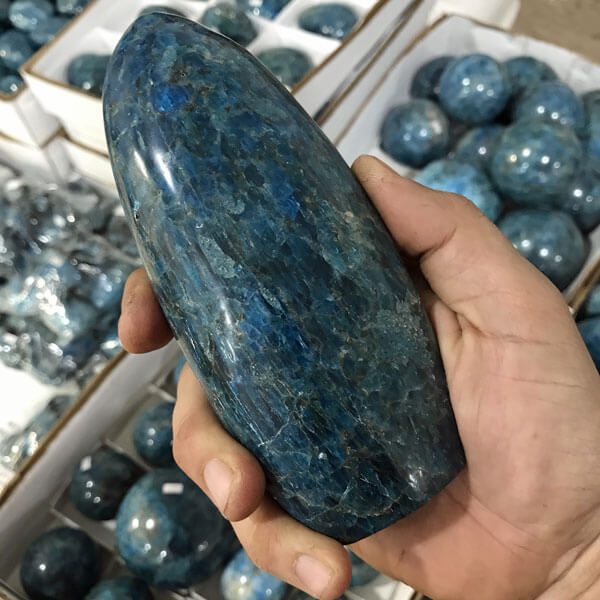
Blue Apatite (Madagascar): The name apatite refers to a group of related phosphate minerals, containing phosphorous and oxygen. They all have the same crystal structure but vary in the amount of hydroxide (bonded oxygen and hydrogen), fluoride, and chloride ions they contain. Its name comes from the Greek apate (“to deceive”). Since apatite comes in such a range of colors, it was commonly confused with other minerals before its discovery. Our bodies use certain apatite varieties to create our teeth and bones.
Availability: Regularly in stock.
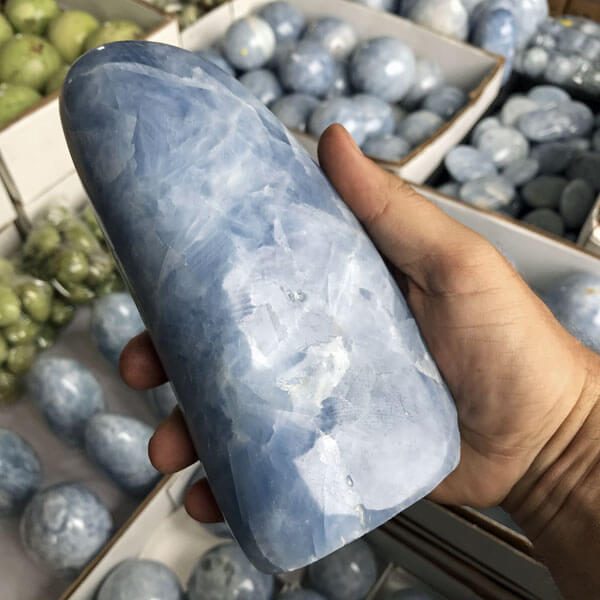
Blue Calcite (Madagascar): The mineral calcite consists of calcium carbonate, a compound of calcium, carbon, and oxygen. The name comes from the German Calcit (without an “e”), after the Latin calx (“lime”). Calcite is the primary component of rocks like limestone and marble. While most calcites are colored by different impurities, the blue may be structural color instead. According to current theories blue calcite is colored by imperfections in its crystal structure caused by translation gliding (deformation from pressure) and exposure to natural underground radiation.
Availability: Regularly in stock.
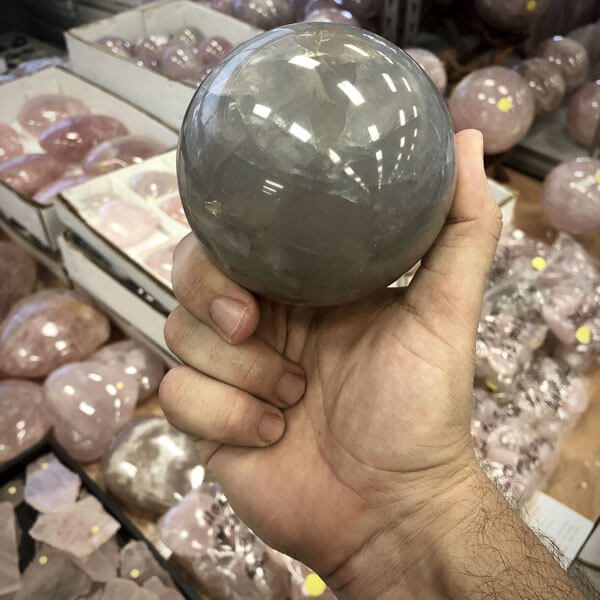
Blue Rose Quartz (Madagascar): While the trade name blue quartz usually refers to pieces colored by blue mineral inclusions like dumortierite, this Madagascan material is structurally colored instead. It looks orange in transmitted light (backlit) but blue in reflected light (under a light source). Some pieces have a floating blue and golden glow that stays in place when turned. These colors are created by the Rayleigh scattering of light on microscopic inclusions. Only a very small amount of Madagascan girasol quartz and rose quartz is tinted blue to bluish gray.
Availability: Variable.
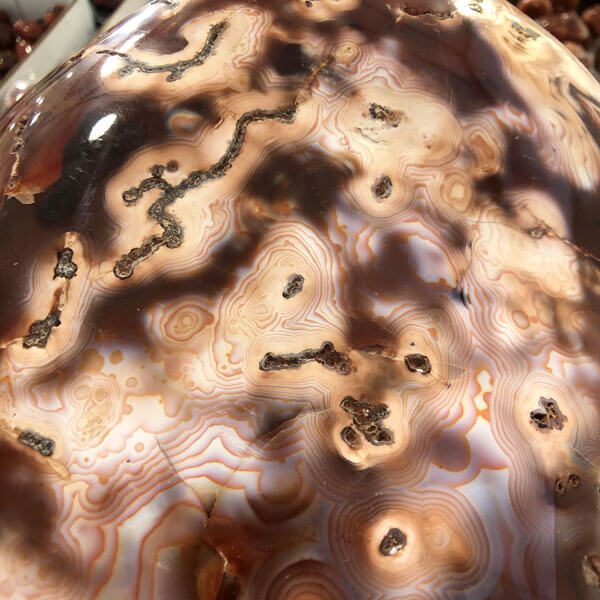
Carnelian (Madagascar): Carnelian is a red variety of the mineral chalcedony, a fibrous variety of quartz that forms in masses rather than points. It may be solid, have agate banding, or form with quartz crystals. The red, orange, and brownish colors come from trace amounts of hematite and hydrated iron oxides suspended within it. The name was influenced by the Latin cornus (“cornelian cherry”), a red dogwood fruit, and the Latin carnem (“flesh, meat”), after its color.
Availability: Regularly in stock.
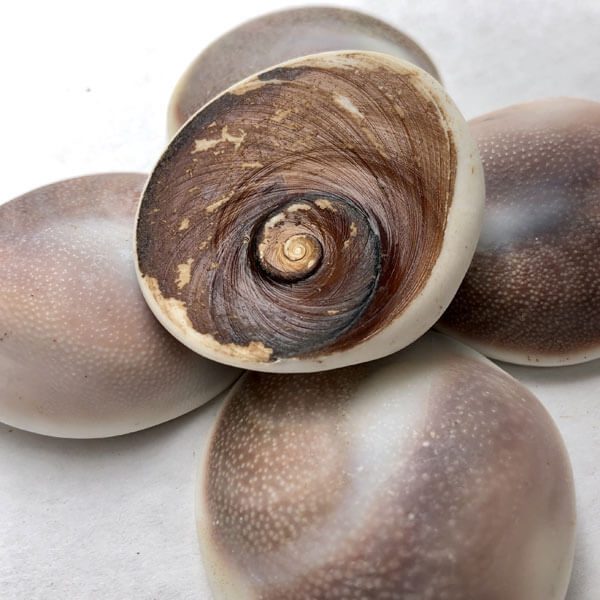
Cat’s Eye Shells (Madagascar): A cat’s eye is a lens shaped shell with a flat spiral face. The rounded side can resemble an eye, with multicolored concentric circles. They are the operculum (Latin, “lid”) of modern turban snails. An operculum is a small secondary shell attached to their foot, used to seal the opening of their main shell when threatened. They consist mostly of the biomineral aragonite, the polymorph of the more familiar calcite, meaning they have the same chemical formula but a different crystal structure.
Availability: Variable.
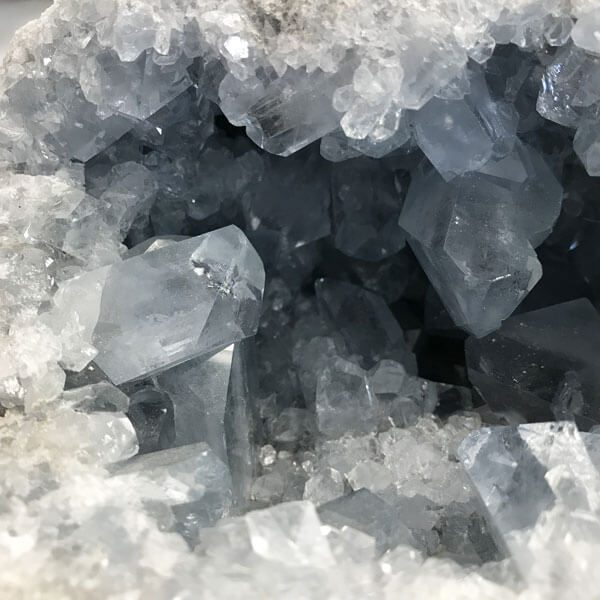
Celestine/”Celestite” (Madagascar): The mineral celestine consists of strontium sulfate, a compound of strontium, oxygen, and sulfur. The word is derived from the Latin coelestis (“celestial”), after the heavenly blue color seen in some specimens. The name “celestite” was officially changed to celestine by the International Mineralogical Association (IMA) in 2004. According to current theories exposure to natural underground radiation separates some of its oxygen from its sulfur. Trace potassium inclusions prevent them from recombining by binding with the oxygen. This change in its crystal structure creates its color.
Availability: Regularly in stock.
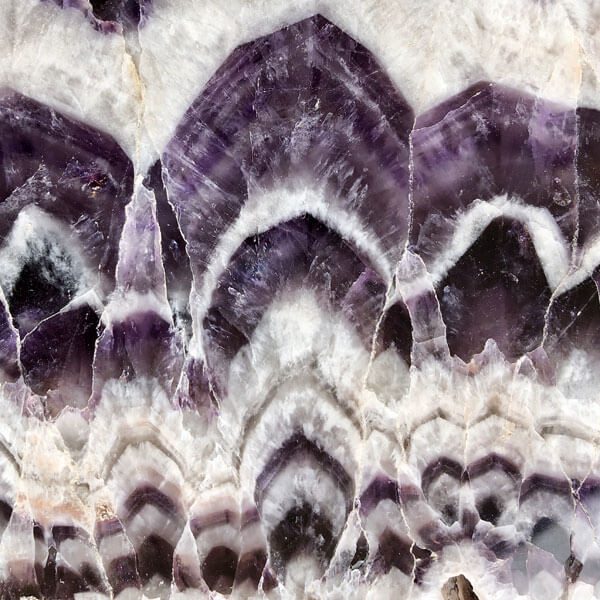
Chevron Amethyst (Madagascar): Chevron amethyst has alternating purple amethyst and white quartz that formed in zigzag layers. The name comes from the French chevron (“rafter”), after the pointed shape. The patterning is caused by periodic changes in its growing environment. Trace amounts of iron color the amethyst and microscopic fluid or gas inclusions make the quartz appear white. We may have Brazilian, Madagascan, and Moroccan chevron amethyst. Both the Brazilian and Madagascan tend to be equal parts purple and white but the latter also includes smoky quartz. The Moroccan is primarily purple.
Availability: Variable.
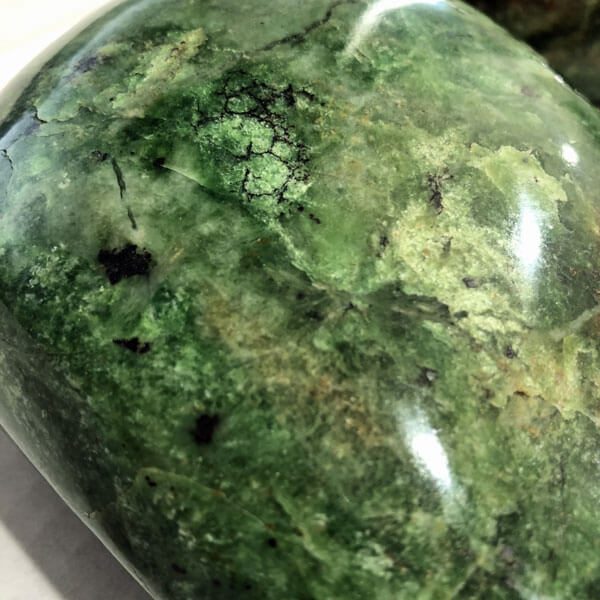
Chrysoprase (Madagascar): Chrysoprase is a green variety of the mineral chalcedony, a fibrous variety of quartz that forms in masses rather than points. The color is caused by dispersed inclusions of nickel bearing silicates like willemseite. Chrysoprase is produced by the weathering of ultramafic rocks like serpentine, similar to garnierite. The name comes from the Greek khrusos (“gold”) and prásinon (“leek green”).
Availability: Currently out of stock.

Citrine (Madagascar): Citrine is a yellow variety of quartz. According to current theories exposure to natural underground radiation causes trace amounts of trivalent iron (Fe3+) or aluminum (Al3+) to replace some of its silicon. This change in its crystal structure creates its color. The name comes from the Latin citrinus (“lemon colored”). Natural citrine is uniform like smoky quartz and often forms with it since both are colored by aluminum.
Availability: Not regularly in stock.
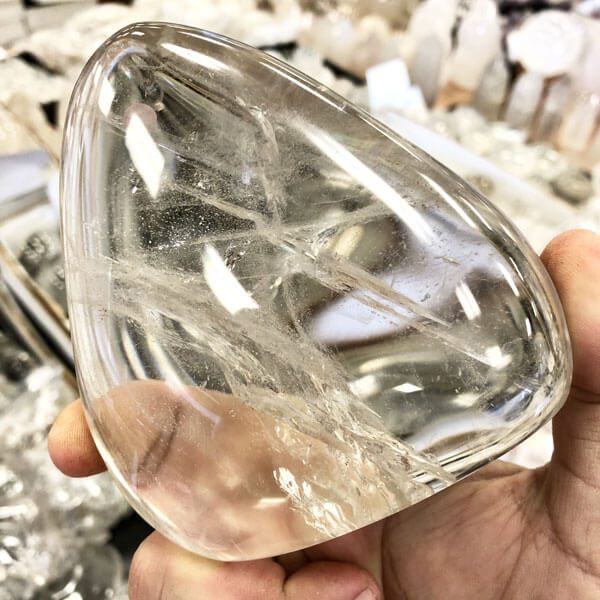
Clear Quartz (Madagascar): Clear quartz was known historically as rock crystal. The name comes from the Greek krystallos (“ice”). Authors in antiquity speculated that quartz was permanently frozen water. Techniques to produce colorless glass were first developed in 15th century Venice. It was called cristallo (Italian, “crystal”) after its resemblance to quartz. Quartz is piezoelectric. It produces an electrical charge when put under mechanical stress. Thin slices of clear quartz are used as crystal oscillators to help clocks keep time and radios stabilize frequencies.
Availability: Regularly in stock.
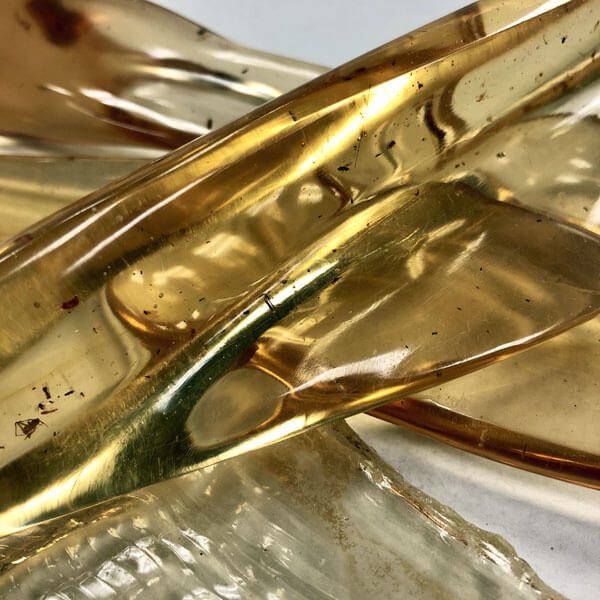
Copal (Madagascar): The Spanish word copal is derived from the Nahuatl copalli ‘incense’. Confusingly the word is used for both fragrant tree resins harvested today in Central America and Mexico and partially fossilized material younger than amber found around the world. (Copal tends to be hundreds of years old and amber millions.) Resins harden over time as they transform into natural polymers. Their molecules are reorganized into chain like groups. For age, locality, and known genera, please visit the fossil map on our website.
Availability: Variable.
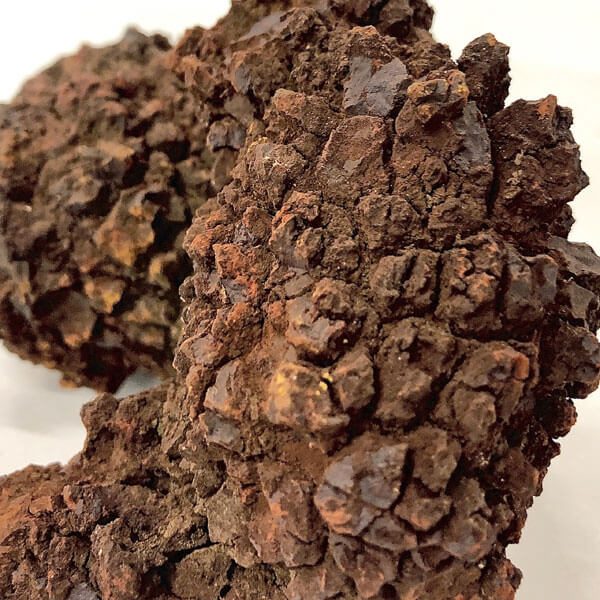
Coprolite (Madagascar): A coprolite is fossilized feces. The name is derived from the Greek kopros “dung”. Madagascan coprolite is sideritic, preserved by the iron oxides siderite and limonite. Sideritic coprolites are currently a matter of debate in the paleontological community. While some people believe they are coprolites, others theorize that they are cololites, fossil casts of the intestinal tract rather then dung, or just iron nodules instead. For age, locality, and known genera, please visit the fossil map on our website.
Availability: Regularly in stock.
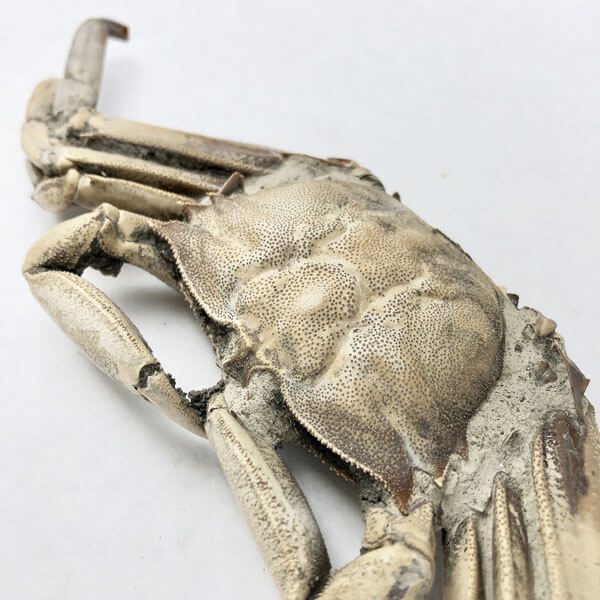
Crab Fossils (Madagascar): Crabs are crustaceans (Latin crustaceus “having a shell or crust”) with five pairs of legs. Two of them are modified into pincers. While crab like animals have evolved at least five times, like king and hermit crabs, the animals we know today as “true crabs” first appeared in the fossil record during the Jurassic period. These Macrophthalmus sp. crabs come from the former Majunga Province of northwestern Madagascar and date from the Pliocene Epoch (5-2.5 million years ago).
Availability: Not regularly in stock.
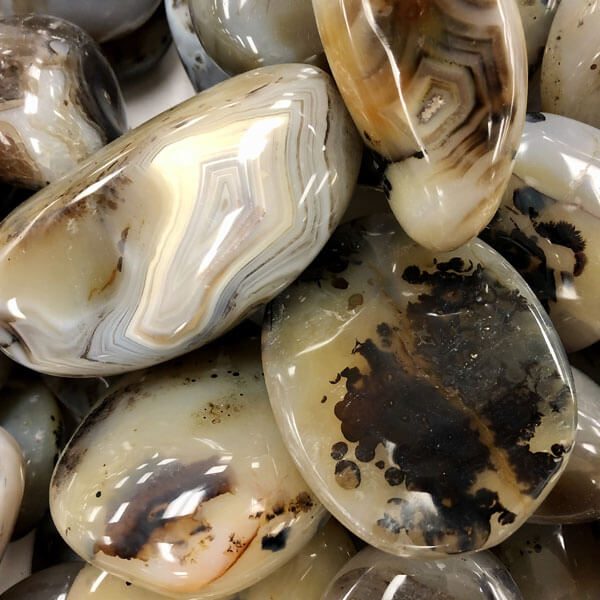
Dendritic Agate (Madagascar): Dendritic agate is a variety of chalcedony with branching iron or manganese oxide inclusions that developed along fine cracks. (Although commonly believed to be pyrolusite, research suggests other manganese oxides are responsible instead.) The name comes from the Greek dendrites (“tree like”). Dendritic agate may have fern like patterning or less distinctive spots and splotches. The latter is sometimes called mosquito agate.
Availability: Regularly in stock.
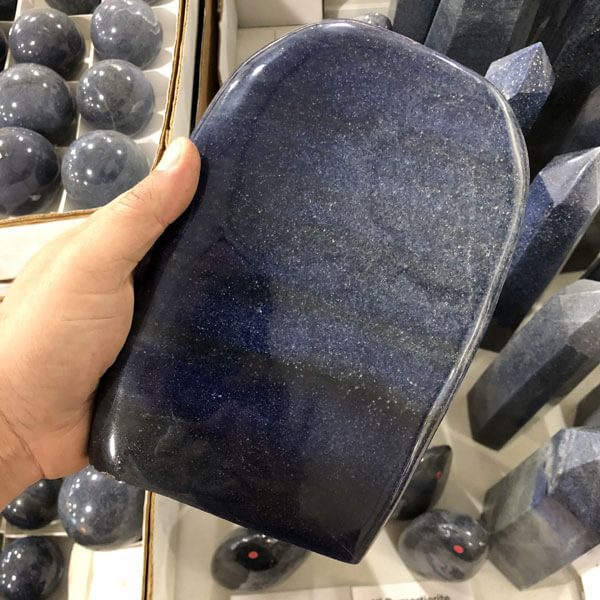
Dumortierite (Madagascar): Until recently this blue rock was thought to be either lazulite or the similarly named lazurite. Lazulite is a phosphate mineral and lazurite is a member of the sodalite group, once thought to be the blue coloring agent of lapis lazuli. (Research now suggests that most material sold as “lazurite” is a sulfide rich variety of hauyne instead. Lazurite as currently defined, more sulfide than sulfate, has only been documented in Russia.) We had samples tested to settle the debate and the results revealed that it was neither. It is dumortierite in quartz instead. Dumortierite is an aluminum borosilicate, a compound of aluminum, boron, silicon, and oxygen. It was originally discovered near Lyon, France in the late 19th century. It was named after the French paleontologist Eugene Dumortier born near the same area.
Availability: Not regularly in stock.

Flexicalymene Trilobites (Morocco): Fossils can preserve the shape of plants or animals in a number of different ways. These Moroccan Flexicalymene sp. trilobites are a steinkern (German Stein “rock” + Kern “pit of a fruit”), a classic name for an internal mold. Their empty shells became filled by sediment, which hardened into stone over time. When the trilobite shells dissolved, all that remained were impressions of their interior surface. Their name comes from the Latin flexibilis (“to bend”) + kalyptein (“to cover”), since many trilobites roll up like pill bugs. For age, locality, and known genera, please visit the fossil map on our website.
Availability: Regularly in stock.
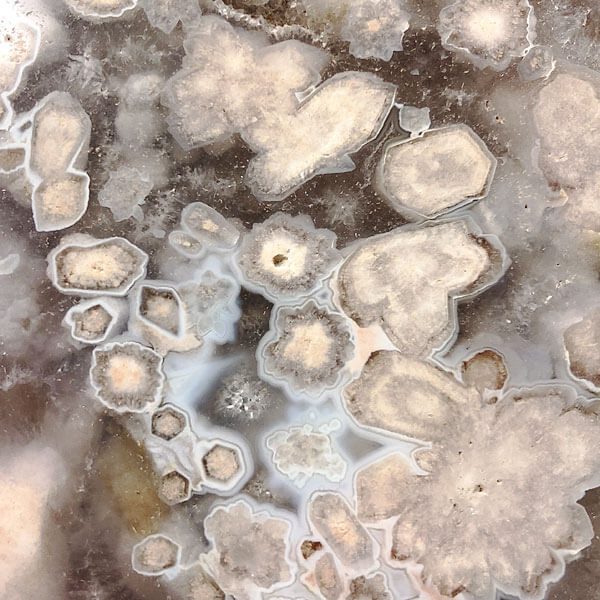
Flower Agate (Madagascar): Flower agate is a light pink, peach, or orange chalcedony with white to cream bloom shaped patterning. Pieces may also display agate banding, blue chalcedony, and quartz crystals. Plume agates have three dimensional shapes caused by mineral inclusions like manganese oxides or stalactite like chalcedony or hydrated silica. It may be sold as cherry blossom or sakura agate, after the Japanese name for the flower. While sometimes dyed on the market, the original Madagascan material is untreated.
Availability: Regularly in stock.
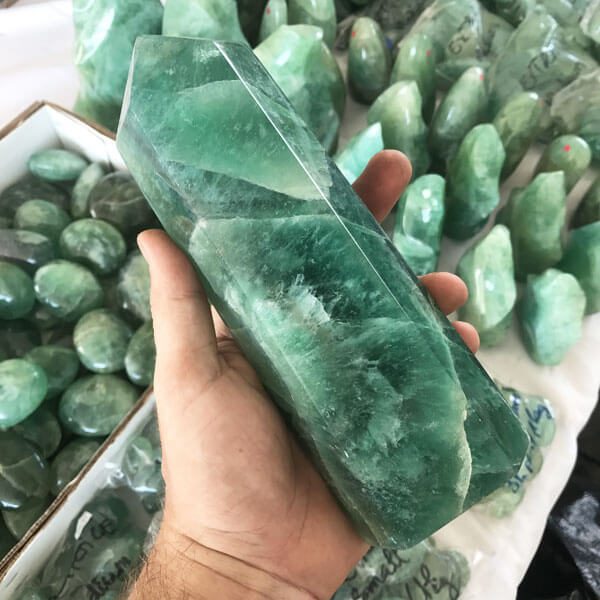
Fluorite (Madagascar): Fluorite consist of calcium fluoride, a compound of calcium and fluorine. The name is derived from the Latin fluere (“to flow”). Fluorite can be used as a flux when smelting metals, promoting fluidity and removing impurities. Most Madagascan fluorite is green. Green fluorite can be colored by a wide range of impurities like iron, manganese, chromium, nickel, copper, and samarium. Some Madagascan fluorite is daylight fluorescent like materials from the Diana Maria and Rogerley Quarry mines in England. While it looks emerald green under artificial light, it shows blue to purple phantoms in daylight.
Availability: Regularly in stock.
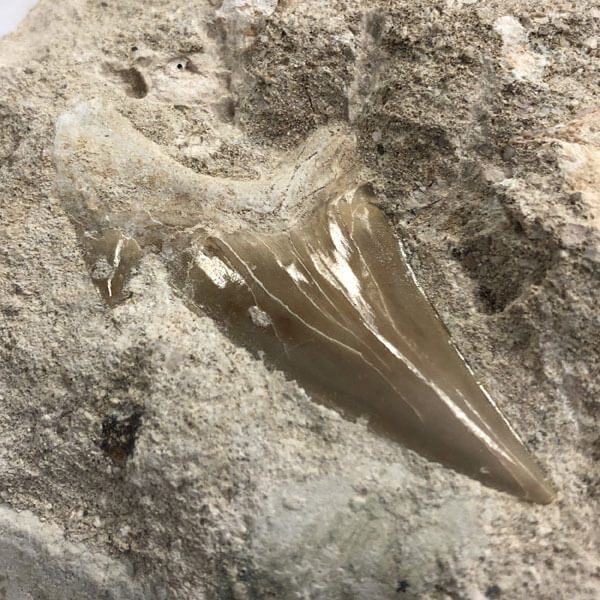
Fossil Shark Teeth (Morocco): These fossil teeth come from an extinct genus of mackerel sharks called Otodus. The name means ear shaped tooth, from the Greek ot “ear” + odous “tooth”. Since shark skeletons are composed of cartilage rather than bone, which breaks down more quickly, they are less commonly preserved in the fossil record. Not only do sharks regularly shed and replace their sturdy teeth, distinctive tooth shape is used to distinguish between shark species. For example, the name Megalodon means “big tooth”. For age, locality, and known genera, please visit the fossil map on our website.
Availability: Regularly in stock.
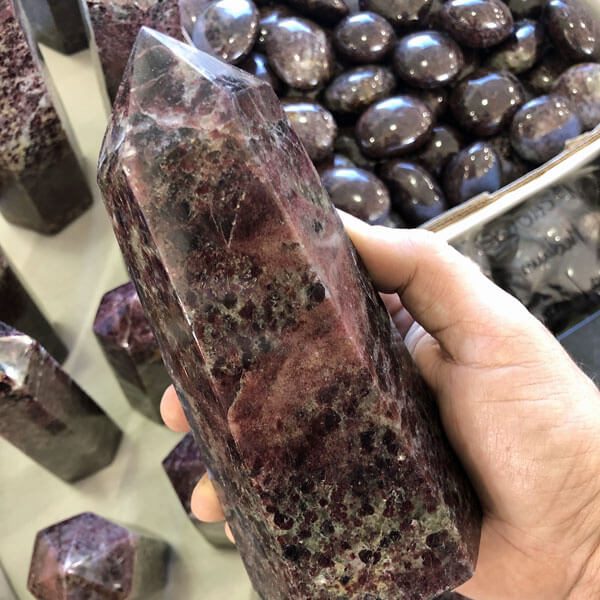
Garnet (Madagascar): Garnet is a not a single mineral but a group of related silicates. They share the same crystal structure but vary in their chemical composition. While they all contain silicon and oxygen, they may also have calcium, magnesium, iron, manganese, aluminum, and chromium. The name comes from the Latin granatum (“pomegranate seed”). Garnet clusters resembled the red arils of the fruit. The material cut and polished into shapes is a garnet granulite, a garnet rich metamorphic rock. Although often labeled grenatite in French speaking Madagascar, that name refers to the minerals staurolite and leucite in English instead.
Availability: Uncommon.
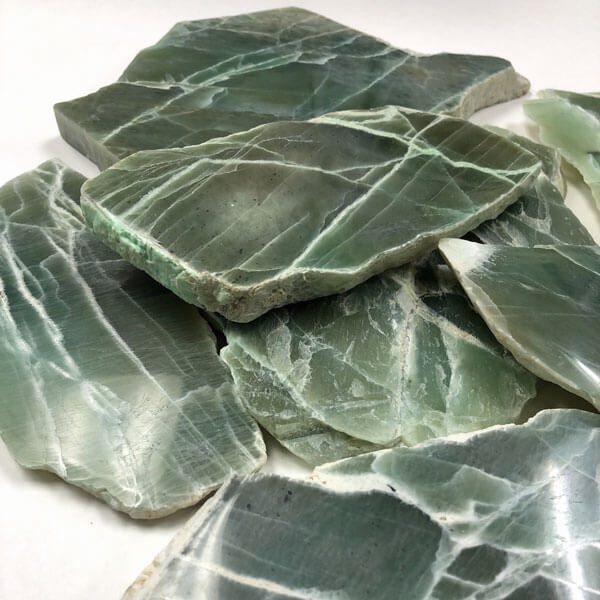
Garnierite (Madagascar): Garnierite is a common name for green nickel magnesium ores. It is not recognized formally as a distinct mineral because its chemistry varies greatly. Garnierite is created by the lateric weathering of ultramafic rocks like serpentine in tropical environments. It is named after the 19th century French geologist Jules Garnier, who researched samples from New Caledonia in the South Pacific. Madagascan garnierite is often sold as green moonstone because it formed along fractures in a gray to beige feldspar. The background occasionally has a white or blue moonstone flash.
Availability: Not regularly in stock.
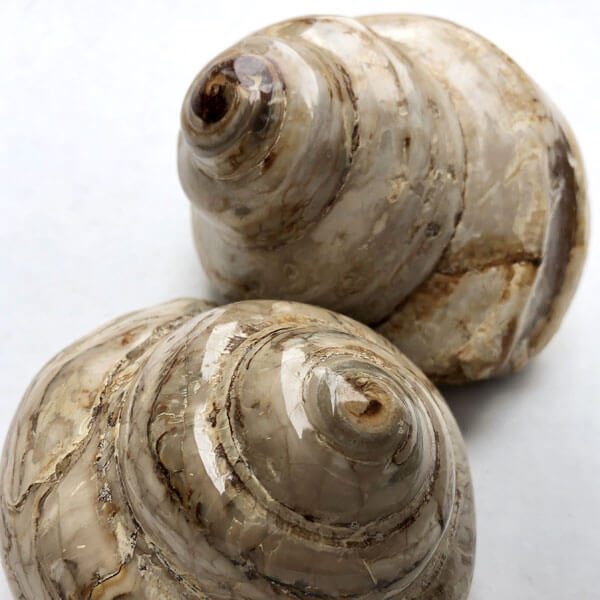
Gastropods (Madagascar): The gastropods are a class of mollusks with a muscular foot on the bottom of their body (Greek gastro “stomach” + pod “foot”). Many of them have a coiled shell, like snails and conchs. These uncommon Madagascan shells are marine snails from the Pleurotomaria genus. They are found near the town of Sakaraha in the Atsimo-Andrefana region of southwest Madagascar, and date from the Late Jurassic Period, Oxfordian Age (~161 to 156 million years ago).
Availability: Not regularly in stock.
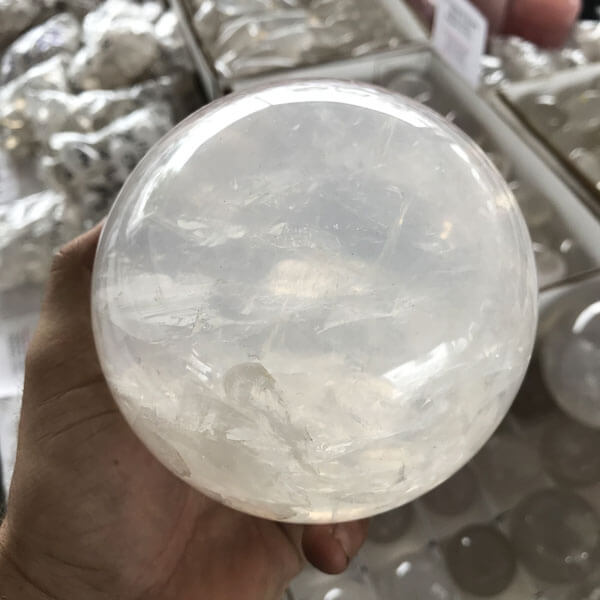
Girasol Quartz (Madagascar): The name “girasol” is given to stones that display a misty opalescence or a floating glow similar to moonstone’s adularescence. The name comes from a Venetian glass called girasole (Italian, “turn to the sun”) invented to replicate opals, colored blue and gold by the Rayleigh scattering of light like opalite. Just as there are star rubies, garnets, and diopsides, the girasol effect may be found in opals, sapphires, and this white variety of Madagascan rose quartz. Girasol quartz comes from the same mines as rose quartz and may also display asterism. According to current theories rose quartz is colored pink by a previously unknown mineral called “dididumortierite”. Unfortunately, color variation in rose quartz is not well understood. Research does suggest that its fibrous inclusions can turn white at certain temperatures. So environmental factors like heat at the time of its formation underground are likely responsible.
Availability: Regularly in stock.
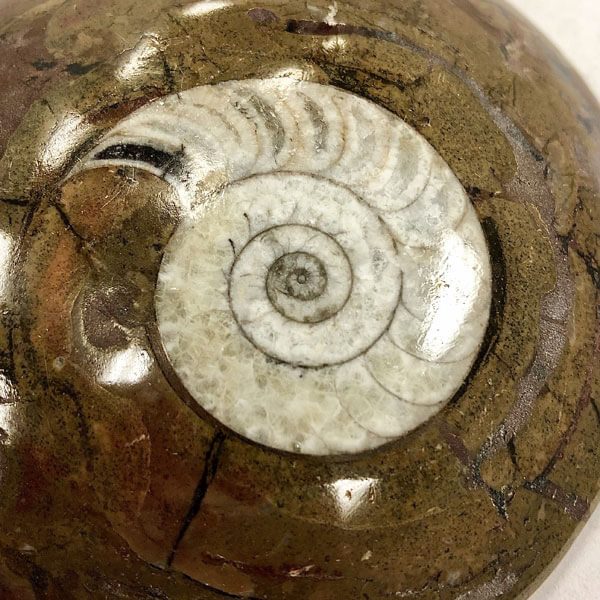
Goniatites (Morocco): The goniatites are early ammonoids that lived from the Middle Devonian to the Late Permian periods (397 – 251 million years ago). (Although the name “ammonite” is commonly used for many prehistoric squid like animals, it technically refers to a specific order. Since the ammonites do not appear in the fossil record until the Early Jurassic [199 million years ago], the more general term ammonoid is used instead.) The goniatites have simpler lobed sutures than the leafy patterning of the ammonites. Their name is derived from the Greek gonia “angle”, after the shape of their sutures. For age, locality, and known genera, please visit the fossil map on our website.
Availability: Variable.

Graphic Amazonite (Madagascar): Graphic amazonite is a common name for a feldspar quartz intergrowth, specifically amazonite with smoky quartz. It is also known as graphic granite. The name graphic is derived from the Greek graphos (“to write”) since the patterning can resemble writing systems like cuneiform, runes, and Chinese characters. It is best seen in material that has been cut in cross sections. Graphic amazonite is produced when smoky quartz and amazonite develop at the same time from a solution.
Availability: Not regularly in stock.
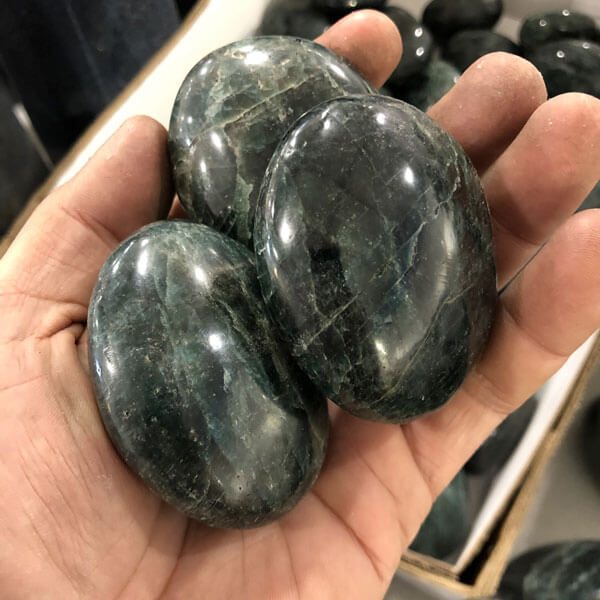
Green Apatite (Madagascar): The name apatite refers to a group of related phosphate minerals, containing phosphorous and oxygen. They all have the same crystal structure but vary in the amount of hydroxide (bonded oxygen and hydrogen), fluoride, and chloride ions they contain. Its name comes from the Greek apate (“to deceive”). Since apatite comes in such a range of colors, it was commonly confused with other minerals before its discovery. Our bodies use certain apatite varieties to create our teeth and bones.
Availability: Regularly in stock.
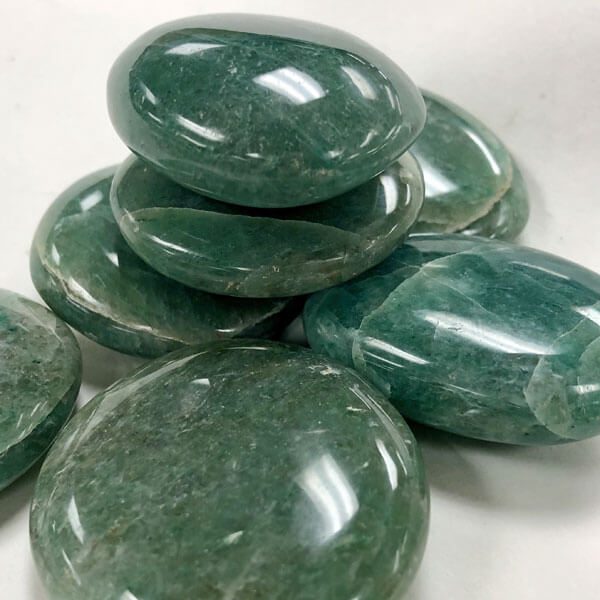
Green Aventurine (Brazil): Green aventurine is a quartzite with inclusions of fuchsite mica, colored green by chromium. Quartzite is a metamorphic rock produced when quartz rich sandstone is altered by heat and pressure underground. The name comes from its resemblance to the 17th century Italian aventurine glass, better known today as goldstone. The word is derived from the Italian avventura “by chance” because the it was created accidentally in folklore.
Availability: Not regularly in stock.
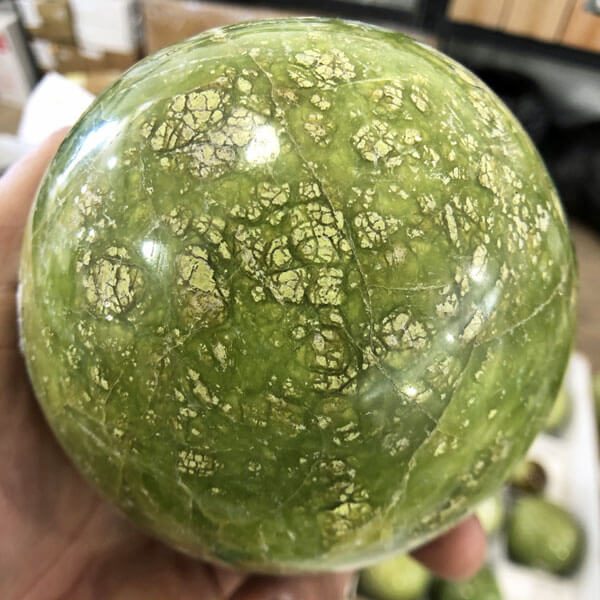
Green Opal (Madagascar): Opal is a mineraloid, a material that lacks a crystal structure but has a regular composition. It may be created by the minerals cristobalite and tridymite or amorphous silica. It is commonly divided into precious opal, which displays a play of color, and common opal. Both consist of silica spheres with interstitial silica and water, filling in the gaps between them. If these spheres are similarly sized and regularly stacked, their arrangement diffracts light producing its play of color. While common opal cannot flash, it may be colored by trace mineral inclusions instead.
Availability: Variable.
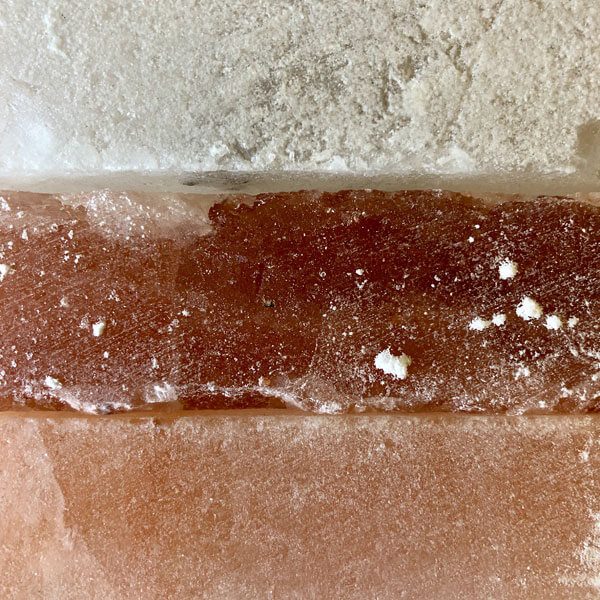
Himalayan Salt (Pakistan): Himalayan salt is a trade name for colorless, pale pink, to rich red halite from the Khewra Salt Mine, in northeastern Pakistan. The locality is at the western edge of the Himalayan Mountains and formed ~250 million years ago, as oceans slowly evaporated during the end of the Permian period. It contains many trace minerals like iron, which produces its pink color.
Availability: Enter the Earth is no longer selling Himalayan salt wholesale.

Ibis Jasper (Madagascar): Ibis Jasper is a name for a recently discovered Madagascan brecciated jasper. Breccia (Italian breccia “breach”) refers to stones broken apart and naturally cemented back together. It can have a shattered appearance like terrazzo or wave like folds. The ibis are long legged waterfowl similar in appearance to a crane. While the better known Egyptian species are white and black, Madagascan ibis are brownish red instead, with touches of white and blue. The stone has a similar color palette. Some pieces also look like feathers or even flocks in flight.
Availability: Variable.
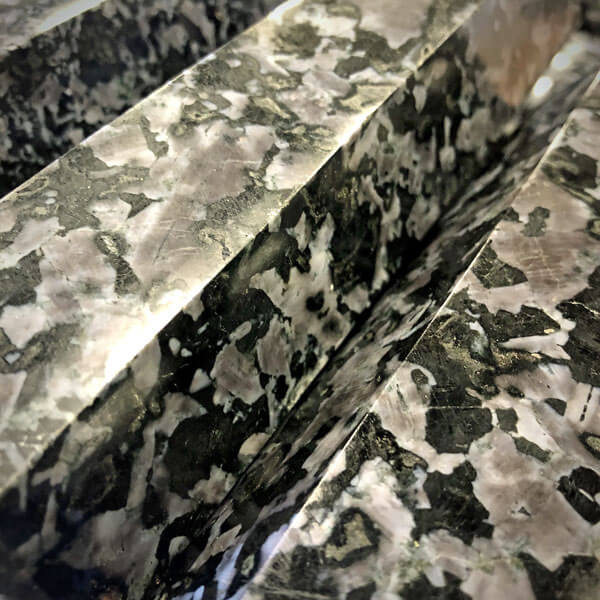
Indigo Gabbro (Madagascar): A gabbro is a type of igneous rock chemically identical to basalt. While basalt forms quickly near the Earth’s surface, gabbro forms slowly underground in the crust. This allows its different mineral components to form patterned visible grains. The name is derived from the village of Gabbro in Tuscany, Italy where it was first documented scientifically. Madagascan indigo gabbro consists of purple to blue glaucophane, black to gunmetal gray plagicolcase feldspar, and sometimes green olivine.
Availability: Variable.
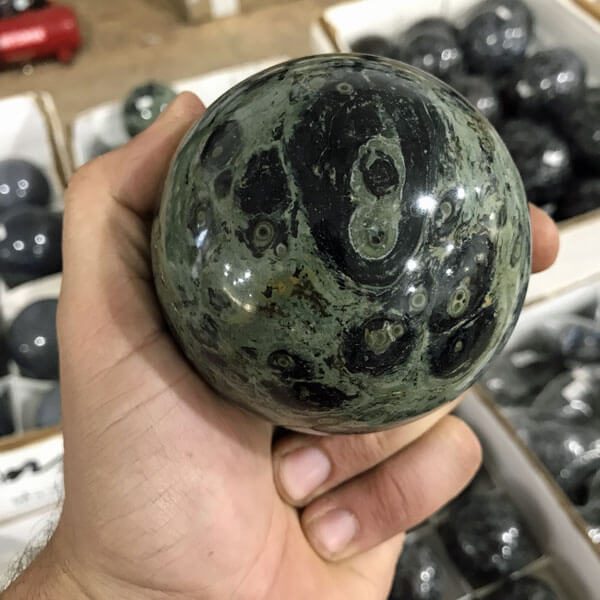
Kabamba Jasper (Madagascar): Kabamba jasper is not actually a jasper. While it was once commonly believed to be a stromatolite, the fossilized impressions of algae colonies, an investigation by the Institut Für Edelstein Prüfung suggests it is not a sedimentary rock but a volcanic rhyolite. It consists of quartz, alkali feldspar, amphibole, aegirine, and trace amounts of calcite. The name kabamba jasper is derived from its place of origin, the area of Kabamba (also spelled Kambaba) in the west central Bongolava region of Madagascar, in the former province of Antananarivo. It is also sold under the trade name crocodile jasper after its eye shaped pattering.
Availability: Regularly in stock.
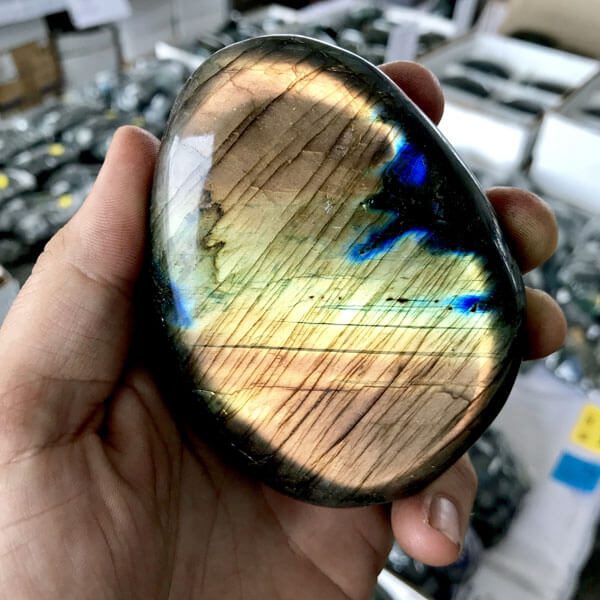
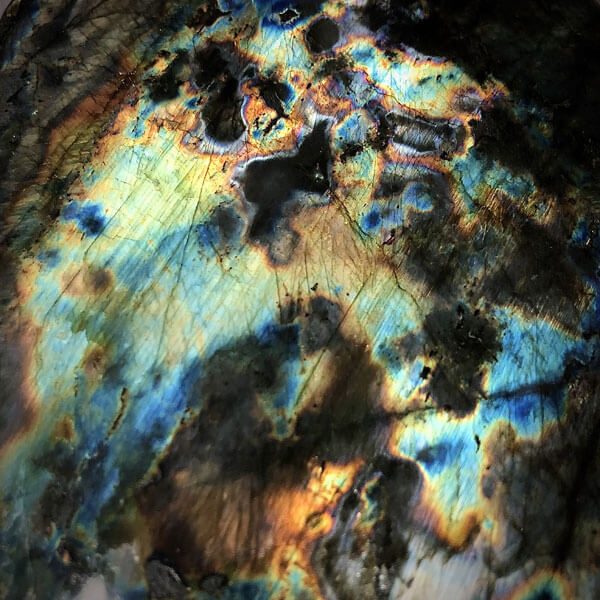
Labradorite (Madagascar): Labradorite is a mixture of two chemically related but slightly different feldspars. Albite contains sodium and anorthite contains calcium. Alternating layers of albite and anorthite start to develop as labradorite cools. Light can reflect off and between them, producing an iridescent play of color known as schiller (Old High German scilihen “to wink’). The name comes from the Labrador Peninsula in eastern Canada. Labradorite was first documented there scientifically by Moravian missionaries in the last 18th century.
Availability: Regularly in stock.
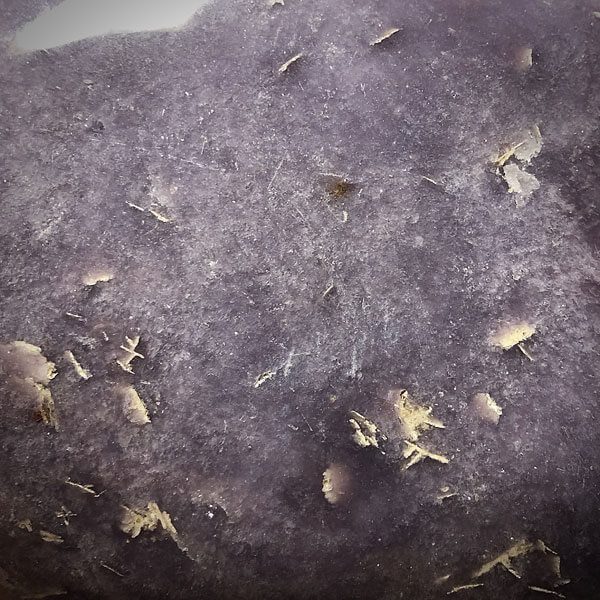
Lepidolite (Madagascar): Lepidolite is a pink to purple variety of mica. Its name come from the Greek lepis (“scale”) after its appearance. Although rich in lithium, current theories attribute its color to trivalent manganese (Mn+3) replacing some of the aluminum in its crystal structure. Lepidolite stopped being recognized as a valid mineral name by the International Mineralogical Association (IMA) in 1989. Scientists determined that it was not a single species but a solid solution between the minerals polylithionite (more lithium) and trilithionite (more aluminium) instead.
Availability: Regularly in stock.
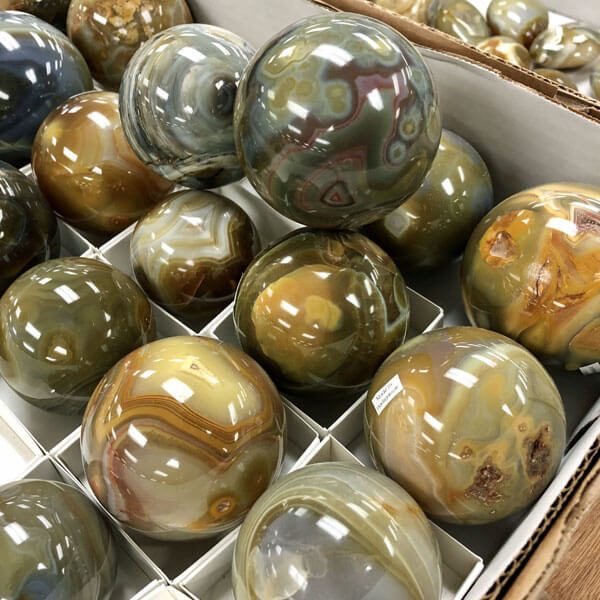
Madagascan Agate (Madagascar): Confusingly the name “Madagascan agate” has been given to two different materials: a heated black, white, and red agate (commonly sold as sardonyx) and a naturally colored agate with muted colors. The latter is typically yellow, brown, or tan with touches of red, black, and white. It is also known as rainbow agate.
Availability: Not regularly in stock.
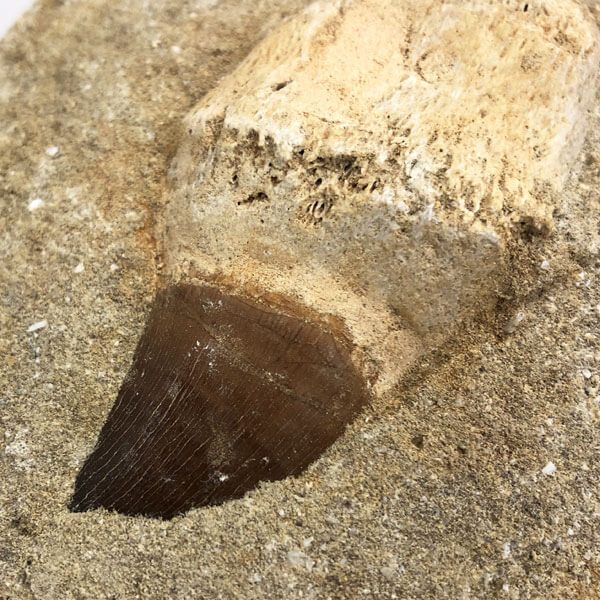
Mosasaurs (Morocco): Aquatic reptiles swam in the prehistoric seas while dinosaurs roamed the earth. The best known are probably the Late Cretaceous mosasaurs (101-65 million years ago). Although they had flippers, a powerful tail, and teeth adapted for specific prey like predatory whales, they had long lizard like bodies instead. Their name comes from the Latin Mosa “Meuse River” + Greek sauros “lizard’, after their discovery in the Netherlands in the late 18th century.
Availability: Not regularly in stock.
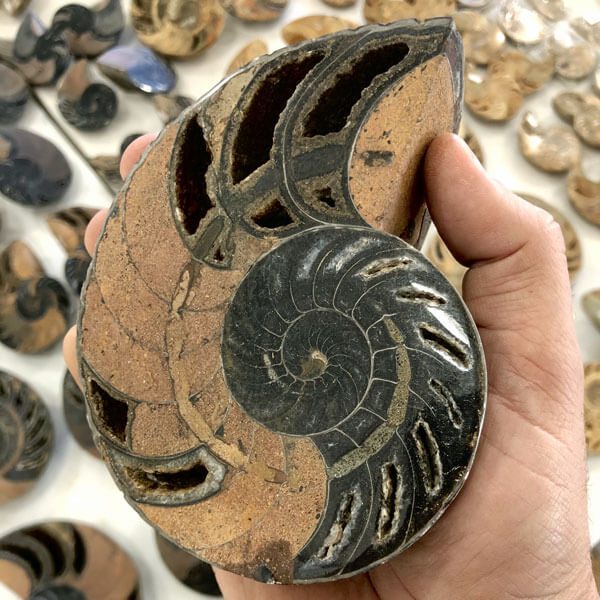
Nautilus (Madagascar): The nautiloids first appear in the fossil record during the Late Cambrian Period (~497 million years ago). While the ammonites went extinct with the dinosaurs, the nautilus continue to live today in the Indian Ocean. The name comes from the Greek nautilos (“sailor”), a historic name for a different animal, the argonaut octopus. Writers in antiquity believed the argonauts traveled across the water like a ship, floating in their temporary shells, while using their tentacles like sails and paddles. When Europeans first encountered the animal we call the nautilus today, they named it after the resemblance. The nautilus has a permanent chambered shell instead. For age, locality, and known genera, please visit the fossil map on our website.
Availability: Regularly in stock.
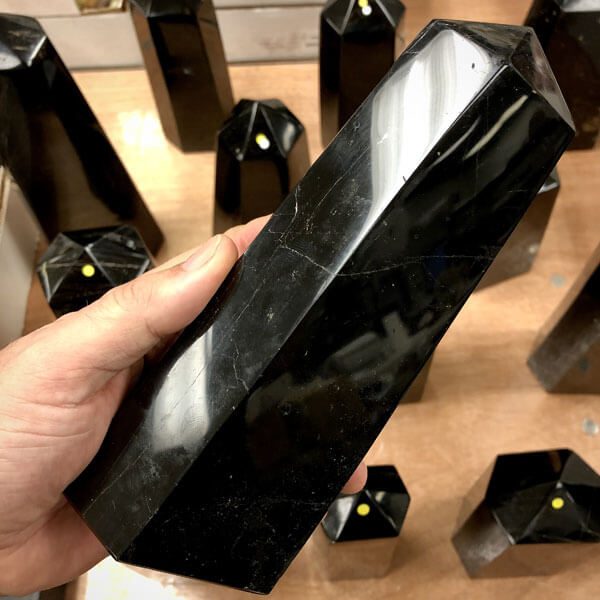
Obsidian (Madagascar): Obsidian is a natural volcanic glass produced by the rapid cooling of lava. Although similar to rhyolite and granite in composition, it lacks a crystal structure. Instead small crystals of different minerals are suspended inside a glass matrix, making it translucent to opaque black. The name comes from the Latin obsidianus lapis (“stone of Obsius”), after a Roman explorer said to have discovered it in Ethiopia. Although Madagascar is not usually known for its obsidian, a deposit was found in the former Tulear Province in 2019.
Availability: Although it is found in abundance in other countries, Madagascan obsidian is not regulary in stock.
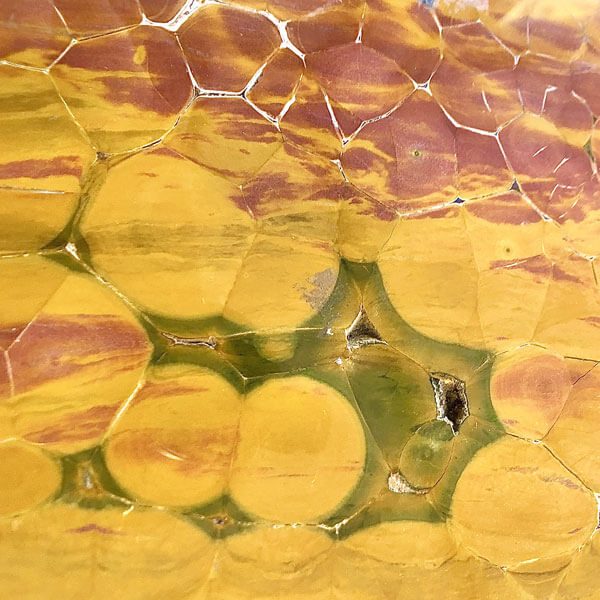
Ocean Jasper® (Kabamby) (Madagascar): While the Ocean Jasper® found near the village of Marovato is better known, a second deposit is found further inland near the village of Kabamby. They are about ten miles apart. While the Marovato material varies greatly in color, Kabamby Ocean Jasper® is consistently green and yellow. It tends to have larger orbs and a polygonal patterning created when they touch. You can read more about them on our geology blog here.
Availability: Not regularly in stock.
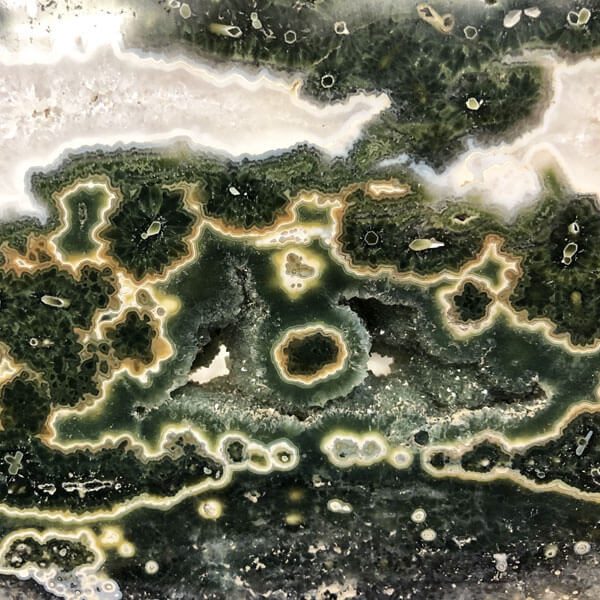
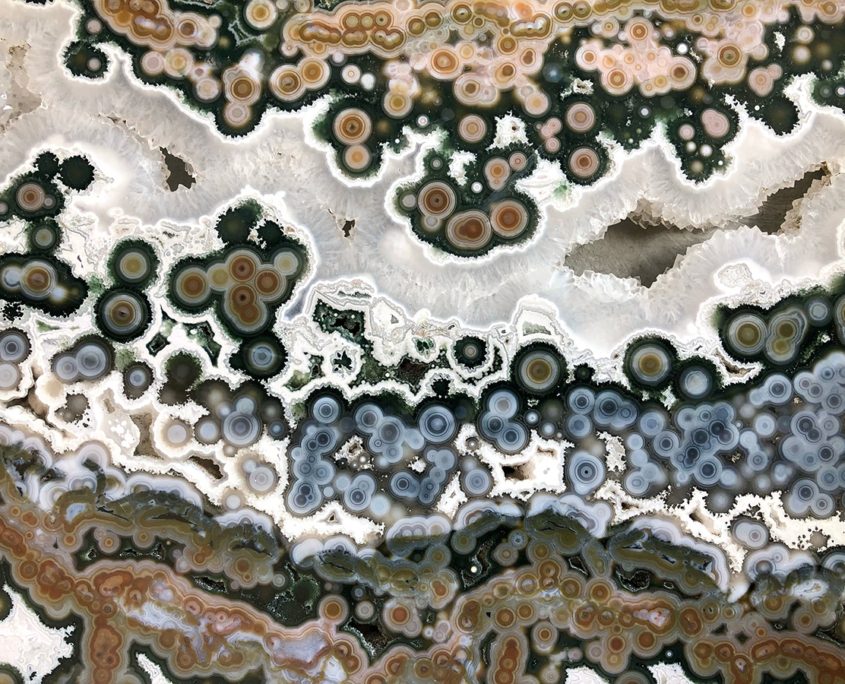
Ocean Jasper® (Marovato) (Madagascar): Ocean Jasper® is not a jasper. It is an orbicular chalcedony instead. It consists of spherical chalcedony, quartz and chalcedony grains, and star bursts and druzes of quartz crystals. Ocean Jasper® was discovered in October 1999 by Paul Obeniche near the village of Marovato. Mr. Obeniche is the mentor of Nader Kawar, the owner of Enter the Earth. We took over operations of the mines when he retired in 2013. Rough material has been found alone, washed out by severe weather, in small pockets, or in a number of different veins. Each vein has distinct characteristics. You can read more about them on our geology blog here.
Availability: Not regularly in stock.
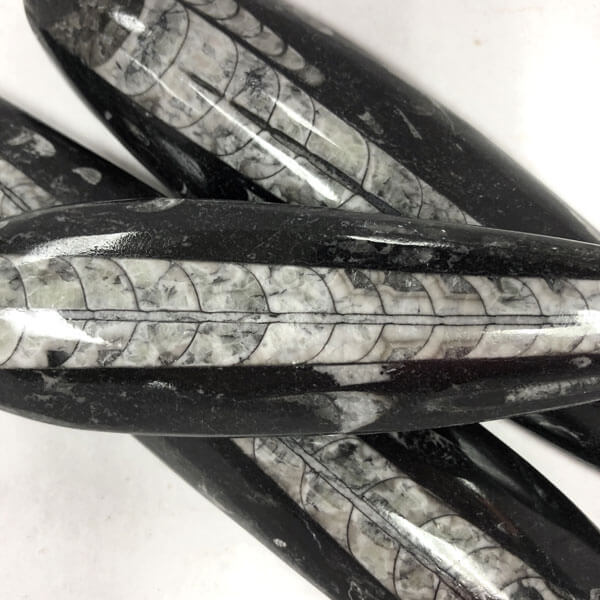
Orthocerid/”Orthoceras” (Morocco): While the name orthoceras was once used for many straight shelled nautiloids, it now refers to a specific genus from Northern Europe. The general term orthocerid is used instead for the Moroccan fossils. Both words are derived from the Greek orthos “straight”, after the shape of their shells. While the surviving nautiloids have curved shells, like the extant nautilus, earlier ones had straight or slightly curved shells. The orthocerid nautiloids first appeared in the fossil record during the Early Ordovician and went extinct during the Late Triassic (485 – 237 million years ago). For age, locality, and known genera, please visit the fossil map on our website.
Availability: Regularly in stock.

Peach Moonstone (Madagascar): The name moonstone is given to feldspars that display a moonlight like glow on their surface called adularescence. The word comes from the mineral adularia, named after Mount Adula in Switzerland. It is produced by the diffraction of light off microscopic layers of alternating orthoclase and albite feldspars. Thinner layers produce a blue flash and thicker ones white. The body color of black, pink, and red moonstone is typically caused by iron oxides.
Availability: Variable.
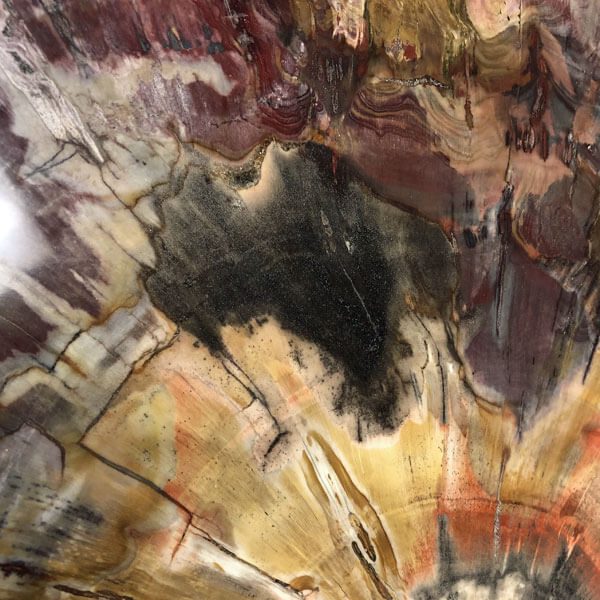
Petrified Wood: Petrified wood is the preserved remains of prehistoric plants, commonly replaced by members of the quartz mineral family like agate, jasper, and opal. The name comes from the Latin petrificāre (petra “stone” +-ficare “to make”). Petrified wood is created by two geological processes called permineralization and replacement. Open spaces inside the wood can be filled by minerals (“permineralization”) or the space once occupied by organic material is replaced entirely as it decays.
Petrified wood is colored by trace inclusions of minerals like iron oxides (red, black, and purple), hydrated iron oxides (orange, yellow, and earth tones), manganese oxides (black and purple), and carbon (black). Because multiple deposits of petrified wood can be combined during processing, it is broadly dated as being Triassic in age.
Availability: Regularly in stock.
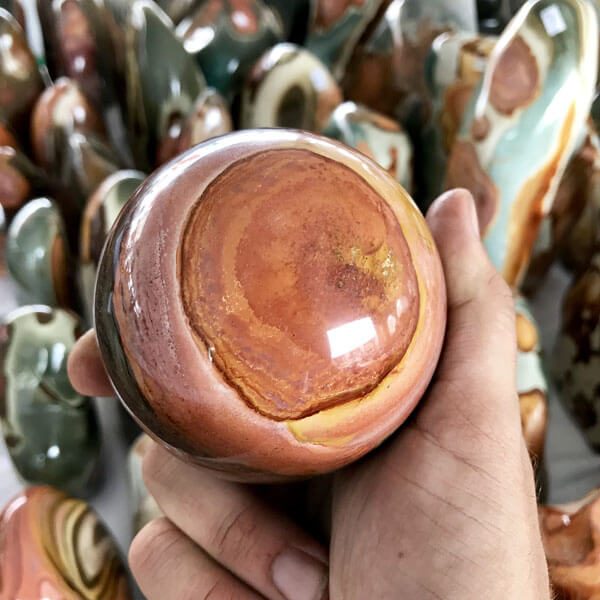
Polychrome Jasper (Madagascar): When the first two Ocean Jasper veins were exhausted in 2006, miners began exploring further inland to find more. While new orbicular material would not be found until 2013, they discovered an entirely new jasper instead. Called jaspe imprime (French, “imprinted or patterned jasper”) in Madagascar, it is better known as polychrome jasper or desert jasper in English speaking countries. Pieces are typically covered in Rorschach test like patterning with warm colors, earth tones, and the occasional green, blue, or purple.
Availability: Regularly in stock.
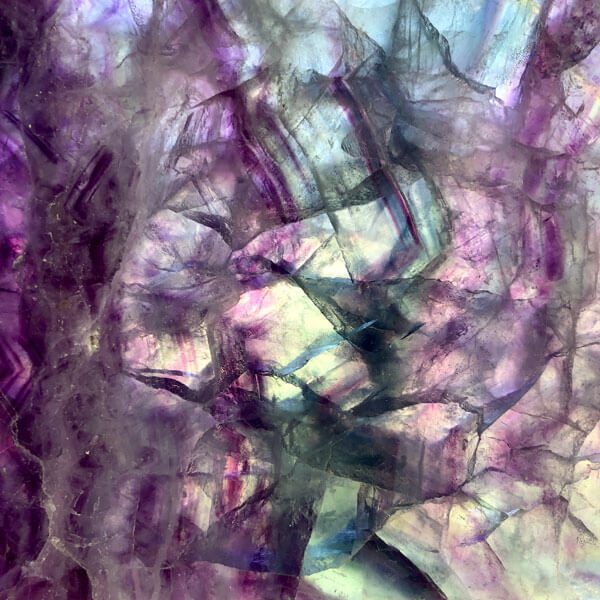
Rainbow Fluorite (China): Rainbow fluorite is a trade name for a multicolored Chinese fluorite. The name comes from its range of differently colored patches or banding. It is typically purple and green, sometimes blue and yellow. While purple and blue fluorite are usually caused by electron color centers, displaced fluorine ions in its crystal structure, green and yellow may come from impurities like iron, manganese, chromium, nickel, copper, and samarium.
Availability: Variable.
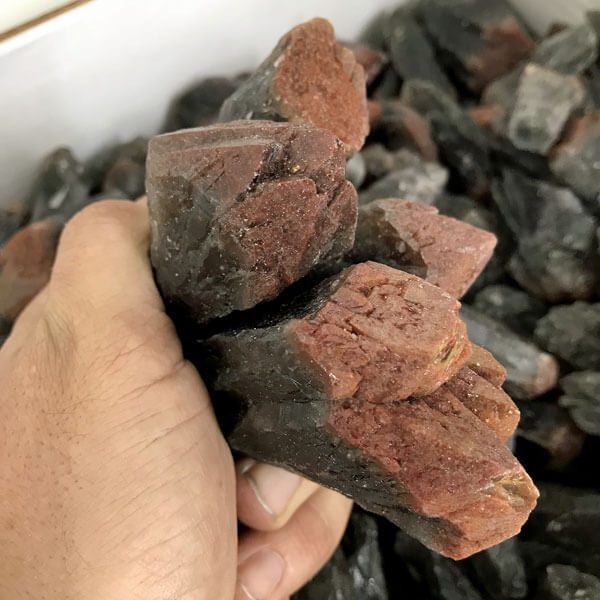
Red Cap Amethyst (Brazil): Super seven is a trademarked name for Brazilian crystals once thought to combine seven minerals: amethyst, clear quartz, and smoky quartz with cacoxenite, goethite, lepidocrocite, and rutile. Unfortunately, the most updated geology only suggests five: the three quartz varieties and two inclusions. The red threads and spangles are both hematite and the gold brooms and black plumes are both goethite. Lepidocrocite is no longer considered a common inclusion in quartz and Brazilian amethyst does not grow in a phosphorous rich enough environment for cacoxenite to form. Since most of this material has hematite phantoms, we sell it as red capped amethyst.
Availability: Regularly in stock.

Red Hematoid Quartz (Madagascar): Hematoid quartz is ferruginous, colored red, yellow, or brownish orange by iron oxides like hematite and limonite. It may be natural or heated to enhance the color by reducing its water content like carnelian. The name is derived from the Greek haimatoeides (“resembling blood”). While any variety of quartz can be ferruginous, this massive Madagascan material is iron bearing rose quartz or girasol quartz.
Availability: Regularly in stock.
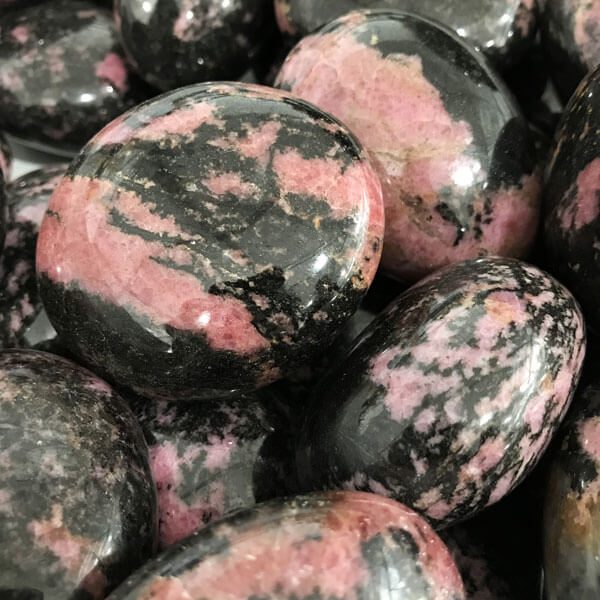
Rhodonite (Madagascar): Rhodonite is a pink manganese silicate with varying amounts of iron, magnesium, and calcium. It often forms with black manganese oxides. It was recognized as group of related minerals with slightly different chemical compositions by the International Mineralogical Association (IMA) in 2019. The group consists of rhodonite (calcium and manganese), ferrorhodonite (calcium, manganese, and iron), and vittinkiite (manganese). The name comes from the Greek rhodon (“rose”), after its color.
Availability: Not regularly in stock.
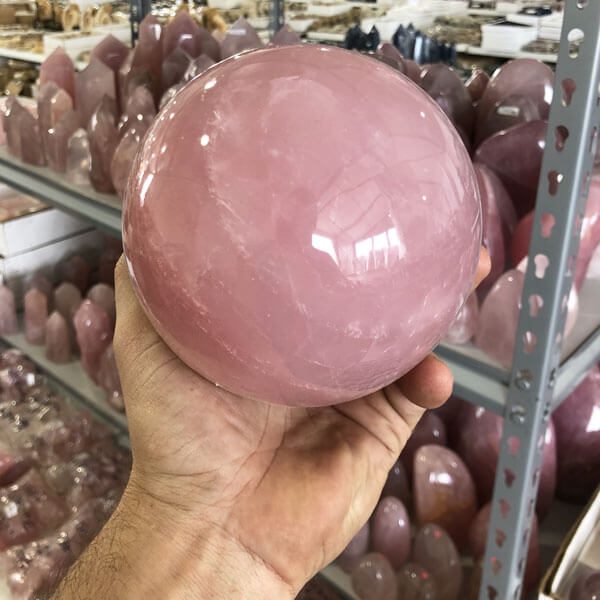
Rose Quartz (Madagascar): The name rose quartz comes from its pink color. According to current theories, it is colored by fibrous inclusions of a previously unknown mineral related to dumortierite. (Some of the original researchers called it “dididumortierite”. The prefix di- is pronounced dee-dee when doubled.) Although dumortierite is typically blue, it may also be pink or purple. The fibers inside rose quartz may be colored by an intervalence charge transfer between iron and titanium. When an electron is passed from one ion to another, it alters the wavelengths of light a mineral absorbs. The same exchange between Fe2+ and Ti4+ gives sapphire its blue color.
Availability: Regularly in stock.
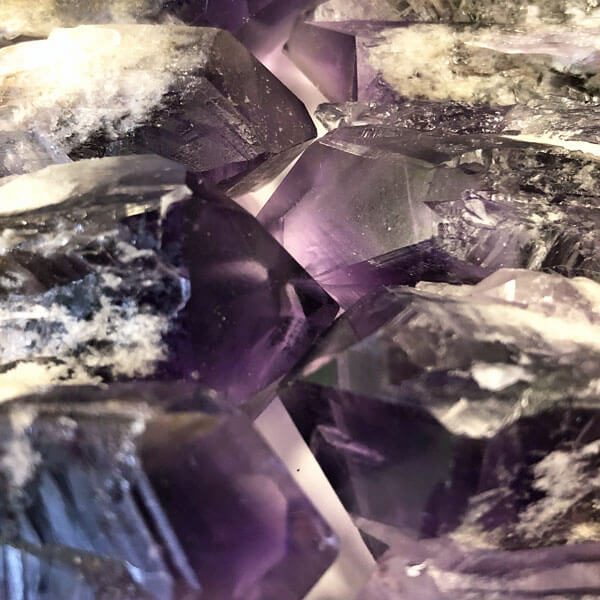
Royal Amethyst (Brazil): Royal amethyst is a trade name for amethyst points from the state of Bahia in eastern Brazil. They are also sold as dragon’s teeth, after their distinctive shape. Direct contact with other crystals produced large points, tapered bottoms, and imprinted groves along the sides. While the tips are typically polished, the body is unpolished.
Availability: Not regularly in stock.
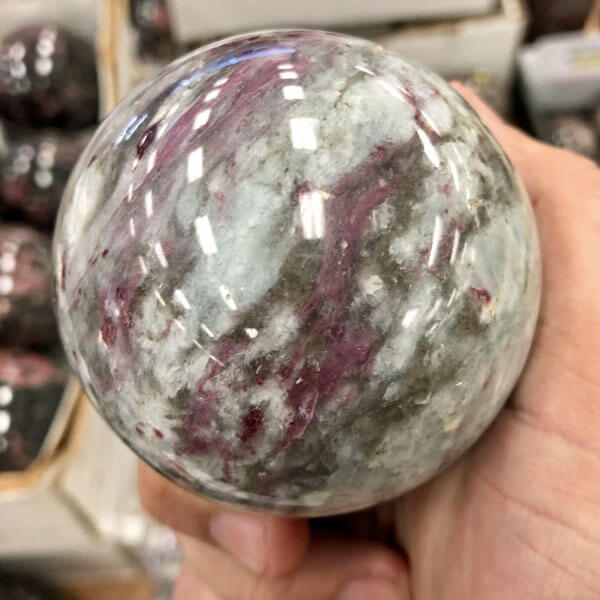
Rubellite (Madagascar): Rubellite is a trade name for pink or red tourmaline. The name comes from the Latin rubellus (“reddish”). Tourmaline is now seen as a group of related minerals rather than a single species. Rubellite is usually a member with more lithium and less iron and manganese like elbaite. The material cut and polished into shapes in rubellite in granite, with clear to milky quartz, smoky quartz, and white feldspar. Although it resembles eudialyte, testing last year did confirm that it is tourmaline.
Availability: Not regularly in stock.
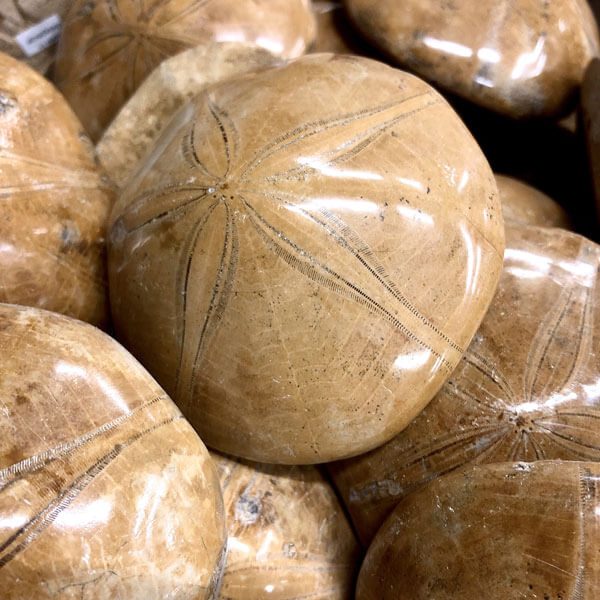
Sand Dollars (Madagascar): The name sand dollar refers to flat sea urchins. Their modified shape allows them to burrow in the sand. Although used for American paper money today, the word dollar is derived from the German Joachimstaler (“silver coins minted in the Czech city of Jachymov”). Sun bleached sand dollars resembled silver dollars. Other historical names are more culinary like sea biscuits or sand cakes. Fossils typically preserve the sand dollar’s exoskeleton. It is more technically called a test, after the Latin testa “bowl”. For age, locality, and known genera, please visit the fossil map on our website.
Availability: Regularly in stock.
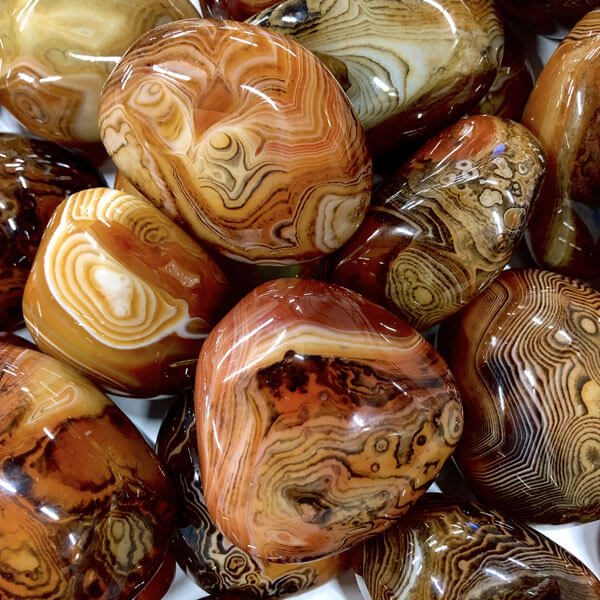
Sardonyx (Madagascar): This Madagascan agate has swirling black, white, and red banding. Although onyx is synonymous with black today, the name was used historically for stones with parallel layers, often black and white. Sard meant brownish red carnelian. Sardonyx has both. Since the name was only used for stones with straight banding, some people call this material “silk agate” or “Madagascar banded agate” instead. While the etymology of sard is debated, onyx comes from the Greek onyx “fingernail”. White and beige onyx can resemble our nails.
Availability: Variable.
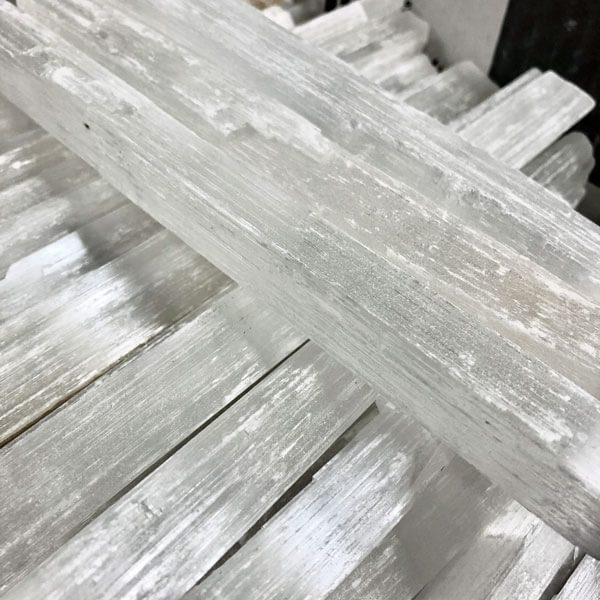
“Selenite”/Satin Spar Gypsum (Morocco): Selenite is a common name for the mineral gypsum. Historically it was only used for transparent crystals and the white fibrous variety was called satin spar instead. (Since the latter was also used for fibrous calcite and aragonite, scientific sources use the name as a prefix. This material is more technically satin spar gypsum.) Pieces may be chatoyant because its structure reflects light like satin. The name selenite is derived from the Greek selēnitēs lithos (“moon stone”), after a stone in folklore said to change its appearance as the moon waxed and waned.
Availability: Regularly in stock.
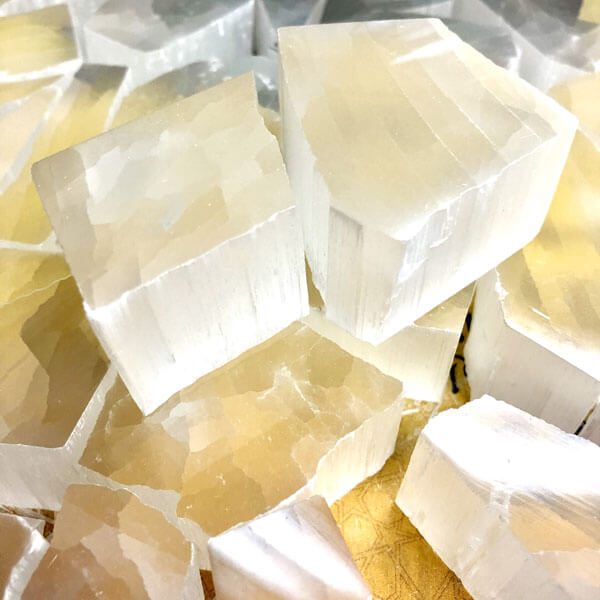
“Selenite”/Satin Spar Gypsum Television Rocks (Morocco): “Television rocks” transmit an image of anything beneath them to their top surface through internal reflection. This optical effect is stronger when pieces are cut and polished perpendicular to the orientation of their fibers. Although both the minerals ulexite and gypsum can be TV rocks, they have slightly different optical properties. Ulexite projections are visible at more of an angle while gypsum is better seen from directly above.
Availability: Regularly in stock.
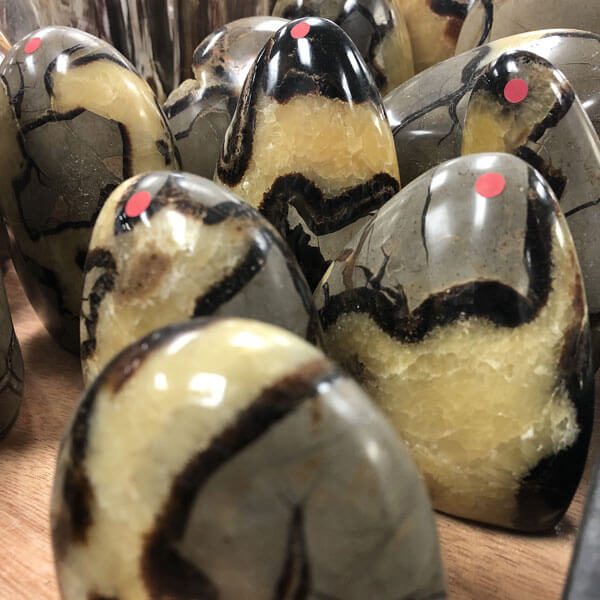
Septaria/Septarian Concretions (Madagascar): Although often called septarian nodules, this sedimentary rock is more technically a concretion. A concretion is a spherical, egg shaped, or irregular mass that forms around a nucleus. They often develop radial cracks that get filled in by other minerals. Their geological formation is still a matter of debate. Madagascan septaria are gray to brown limestone with yellow calcite and brown to black aragonite. Some pieces have colorless baryte. The name septarium (plural septaria) comes from the Latin septum (“partition”).
Availability: Regularly in stock.
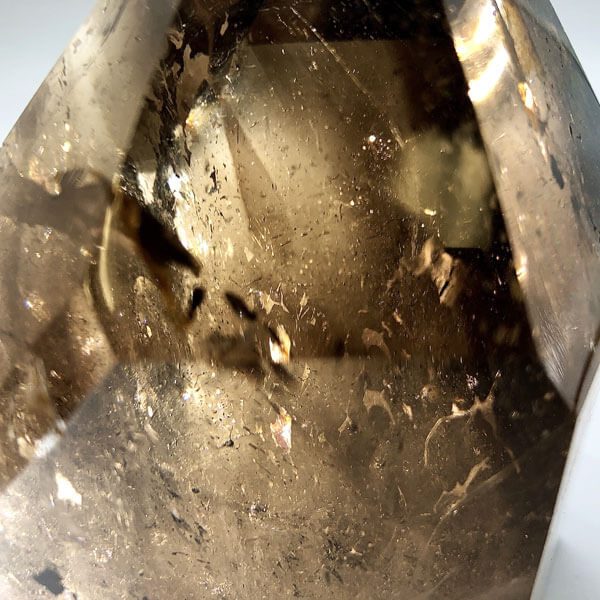
Smoky Quartz (Madagascar): Smoky quartz is a brown to black variety of quartz. According to current theories exposure to natural underground radiation causes trace amounts of trivalent aluminum (Al3+) to replace some of its silicon. This change in its crystal structure creates its color. The name has changed slightly over time. Many historical sources called it “smoked quartz” instead, after its resemblance to smoke cured foods. Since natural irradiated color develops slowly below certain temperatures, smoky quartz tends to be found in specific environments like higher elevations where it had time to slowly darken.
Availability: Regularly in stock.
Availability: Variable.
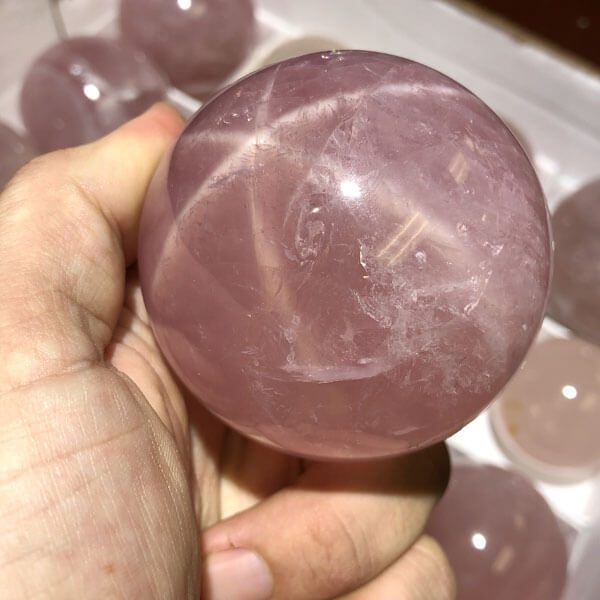
Star Rose Quartz (Madagascar): Madagascan rose quartz may display asterism when cut and polished in the round like a sphere. Asterism (Greek aster “star”) is an optical effect where intersecting bands of light appear to move across the surface of a stone. Because quartz is hexagonal, rose quartz produces six rayed ones. The stars are caused by light scattering off fibrous inclusions oriented along its crystal structure. Although once commonly thought to be rutile, the most recent research suggests that “dididumortierite” fibers are responsible instead.
Availability: Regularly in stock.
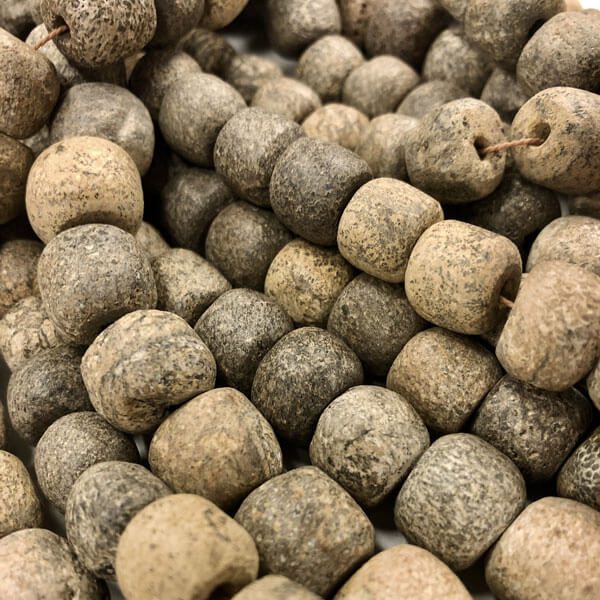
Stegodons (Indonesia): The stegodons are an extinct group of animals distantly related to the modern elephant. Based on their skeleton, they resembled today’s animal but were larger with more prominent tusks. Their name comes from the Greek stegein (“roof”) and odous (“tooth”), after the gable shaped ridges of their teeth. Distinct tooth shape is the most common way to differentiate elephant like animals. For example, the name mastodon means “breast shaped teeth”. For age, locality, and known genera, please visit the fossil map on our website.
Availability: Regularly in stock.

Sugar Quartz Geodes: Updated description coming soon.
Availability: Regularly in stock.
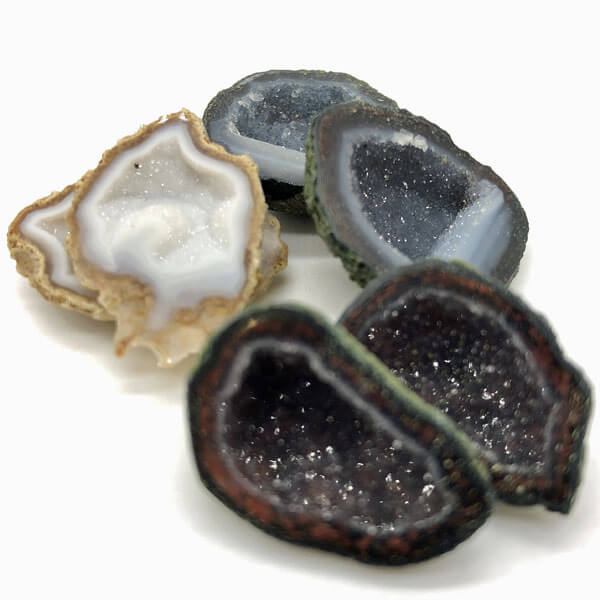
Tabasco Geodes (Mexico): A geode is a hollow rock lined with crystals or layered minerals like chalcedony. The name comes from the Greek geodes (“earth like”). Tabasco geodes are mined near the town of Tabasco in the state of Zacatecas, Mexico. They tend to be small, with a quartz druze, and naturally colored agate. While originally discovered in the 1970’s, new deposits have been worked recently.
Availability: Not regularly in stock.
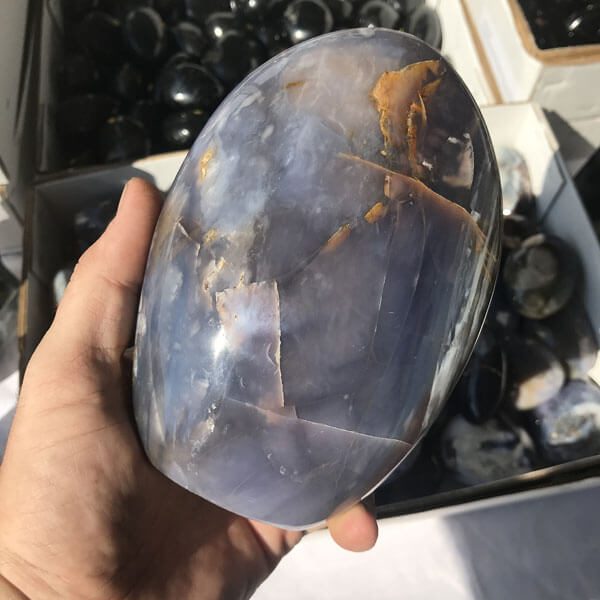
Violet Agate (Madagascar): Violet agate is a purple Madagascan chalcedony. Pieces are usually a patchwork of purple, red, black, white, and brown. Purple chalcedony is typically colored by iron or manganese. Violet agate is commonly sold as violet flame agate. The violet flame is a spiritual concept that originated in early 20th century ascended master teachings associated with purification, transformation, and spiritual evolution.
Availability: Not regularly in stock.
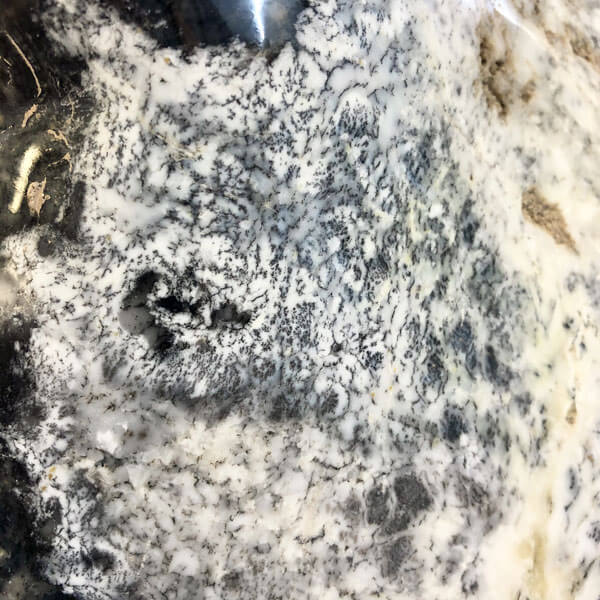
White Dendritic Agate (Madagascar): White dendritic agate is a white, cream, or gray chalcedony with black dendrites. Occasionally pieces have light purple, green, or yellow patches. Although it resembles dendritic opal found in other countries, testing has confirmed that this material is chalcedony. While commonly sold as psilomelane included chalcedony, analysis has never been done on the composition of its dendrites. (Additionally, psilomelane stopped being recognized as a distinct mineral by the IMA [International Mineralogical Association] in 1984. While still commonly used for mixed manganese oxides, specific species names like romanechite are preferred when known.)
Availability: Variable.
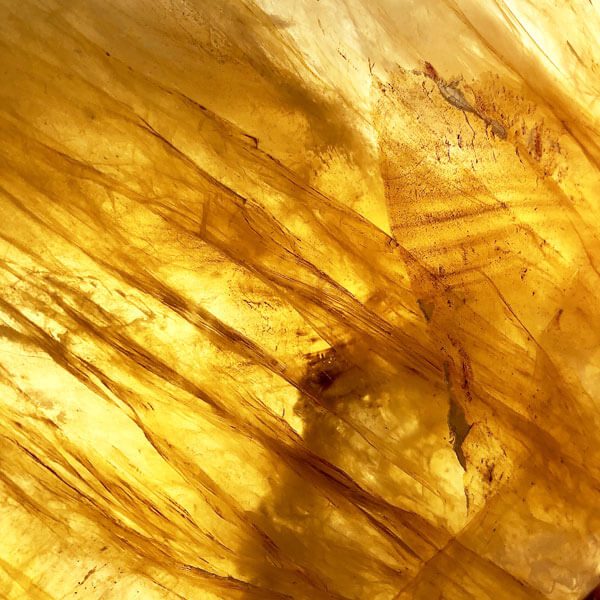
Yellow Hematoid Quartz (Madagascar): Although its name means “blood like” (Greek haimatoeides), yellow hematoid quartz is gold rather than red. While all hematoid quartz is colored by iron oxides, the mineral limonite in the yellow is more hydrated than the hematite in the red. Limonite is derived from the Greek leimōn “swamp”. Limonite rich bog ore was an early source of iron. While any variety of quartz can be ferruginous, this massive Madagascan material is iron bearing rose quartz or girasol quartz.
Availability: Regularly in stock.
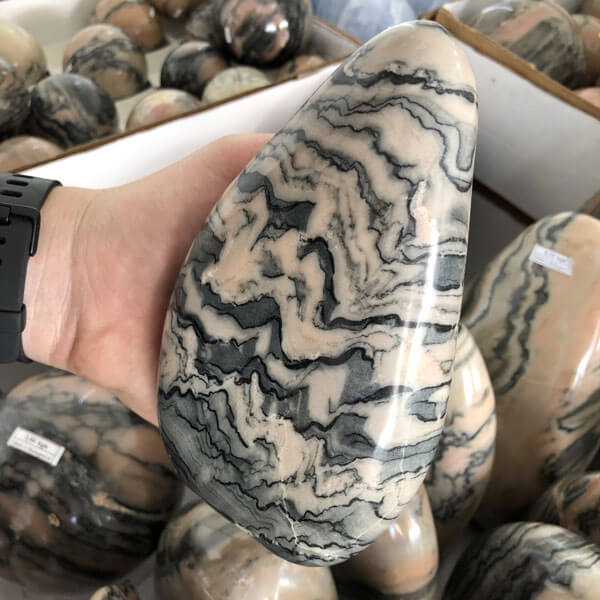
Zebra Calcite (Madagascar): Zebra calcite is a trade name for a peach, black, and white calcite with a zigzag patterning. Black, red, and pink calcite are usually colored by manganese oxides and iron oxides. The striations are caused by its layered formation and the different colors by periodic changes in its impurities.
Availability: Not regularly in stock.
Sign up for our newsletter and get the latest updates on new products and upcoming sales.